For years, I looked at my monthly utility bill with a mix of confusion and dread. Living in the U.S., especially during peak winter or summer months, feels like a constant battle against the thermostat. I tried the usual advice—turning off lights and unplugging the toaster—but the needle barely moved.
That changed when I decided to stop guessing and started using AI-driven energy optimization. In this guide, I’ll share exactly which tools I used, how I set them up, and the real-world results I saw.
1. The “Aha!” Moment: Why Traditional Savings Fail
Most of us have no idea where our electricity actually goes. We suspect the AC or the fridge, but we don’t know. Traditional “dumb” appliances just pull power. AI tools, however, use Machine Learning to identify the unique “electrical signature” of every device in your home.
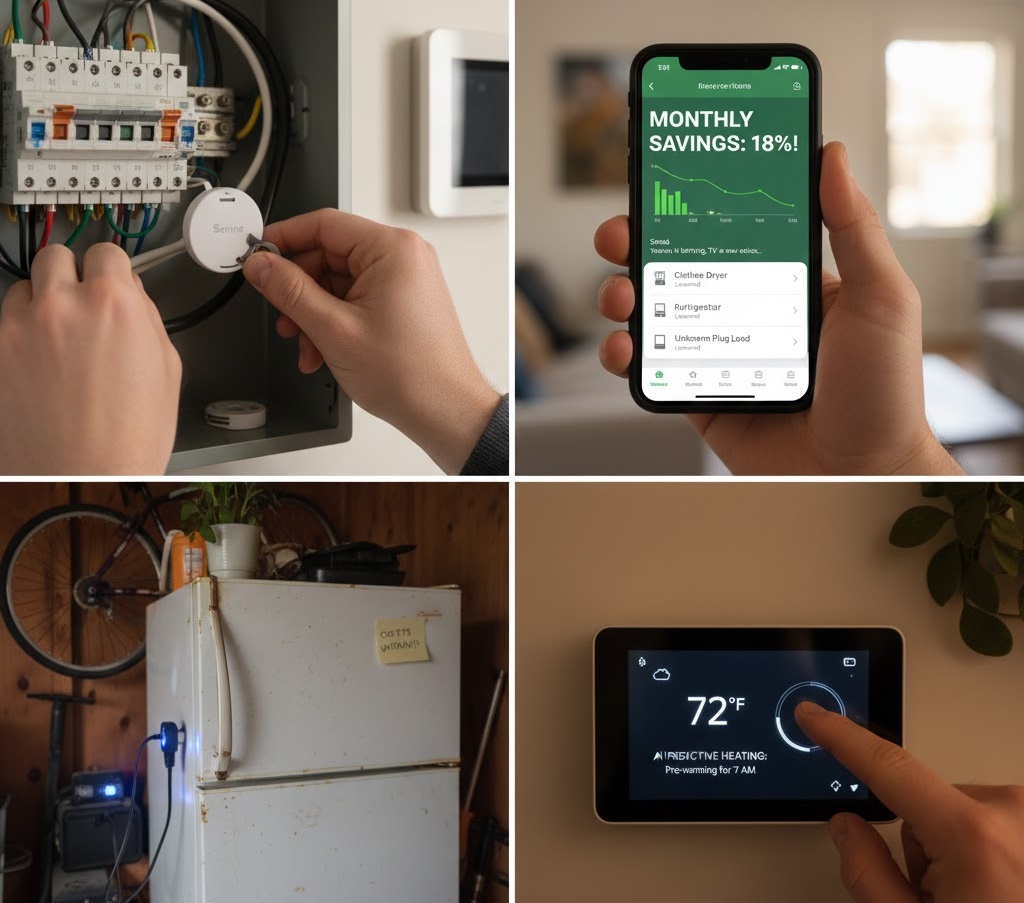
When I first installed an AI monitor, I discovered that an old second fridge in my garage was cycling incorrectly and costing me an extra $25 a month. I would have never found that without AI.
2. My Top Picks: AI Tools That Actually Work
I tested several devices and apps over the last six months. Here is how they compared in terms of ease of use and actual savings:
Comparison Table: Top AI Energy Tools for 2026
| Tool Name | Type | Key AI Feature | Estimated Savings | My Rating |
| Sense Home Monitor | Hardware | Device Recognition via Machine Learning | 15-20% | ⭐⭐⭐⭐⭐ |
| Ecobee Smart Thermostat | Hardware | Occupancy & Weather Prediction | 23% on HVAC | ⭐⭐⭐⭐ |
| OhmConnect | App/Service | Real-time Grid Optimization AI | Cash Rewards | ⭐⭐⭐ |
| Emporia Vue (Gen 3) | Hardware | Real-time Circuit Analysis | 10-15% | ⭐⭐⭐⭐ |
3. Step-by-Step: How I Optimized My Home
If you want to replicate my results, here is the exact protocol I followed:
Step 1: Install a “Brain” for Your Electrical Panel
I started with the Sense Home Monitor. You (or an electrician) clip it onto the main sensors of your breaker box. After about a week, the AI began “learning.” It sent me a notification: “I found your clothes dryer.” Then, “I found your microwave.” Step 2: Automate with Predictive Heating/Cooling
I swapped my old thermostat for an AI-enabled one. Unlike basic programmable thermostats, this one uses AI to look at the local weather forecast. If it knows a heatwave is coming at 2 PM, it pre-cools the house at 10 AM when electricity is cheaper and the AC is more efficient.
Step 3: Hunt the “Energy Vampires”
Using the AI app, I walked around my house and saw my “Always On” load was 300 watts. That’s like leaving 30 LED bulbs on 24/7! I used the AI insights to find that my old gaming PC and a laser printer were the main culprits. I put them on smart plugs that the AI can turn off when I’m asleep.
4. The Results: Show Me the Money
I found that my baseline energy consumption dropped by 18% in the first three months. In a typical American household spending $150/month, that’s a saving of over $300 a year—meaning the AI gear pays for itself in less than 8 months.
Final Thoughts
Using AI for energy isn’t just about being “high-tech”; it’s about taking control of the biggest hidden cost in our homes. If you’re tired of the “utility bill lottery,” it’s time to let algorithms do the heavy lifting.
Related posts:
 Weather Tomorrow: Your Global Forecast and Travel Outlook for January 8, 2026
 Zero-Day Emergency: Apple Confirms Active WebKit Attacks—All iPhone Users Must Update to iOS 26.2 Now
 From GTA to AI Nightmares: Dan Houser Returns with His Darkest Vision Yet in A Better Paradise
 Bittersweet Shift in Gaming Leadership Glen Schofield on EA and Activision Sales