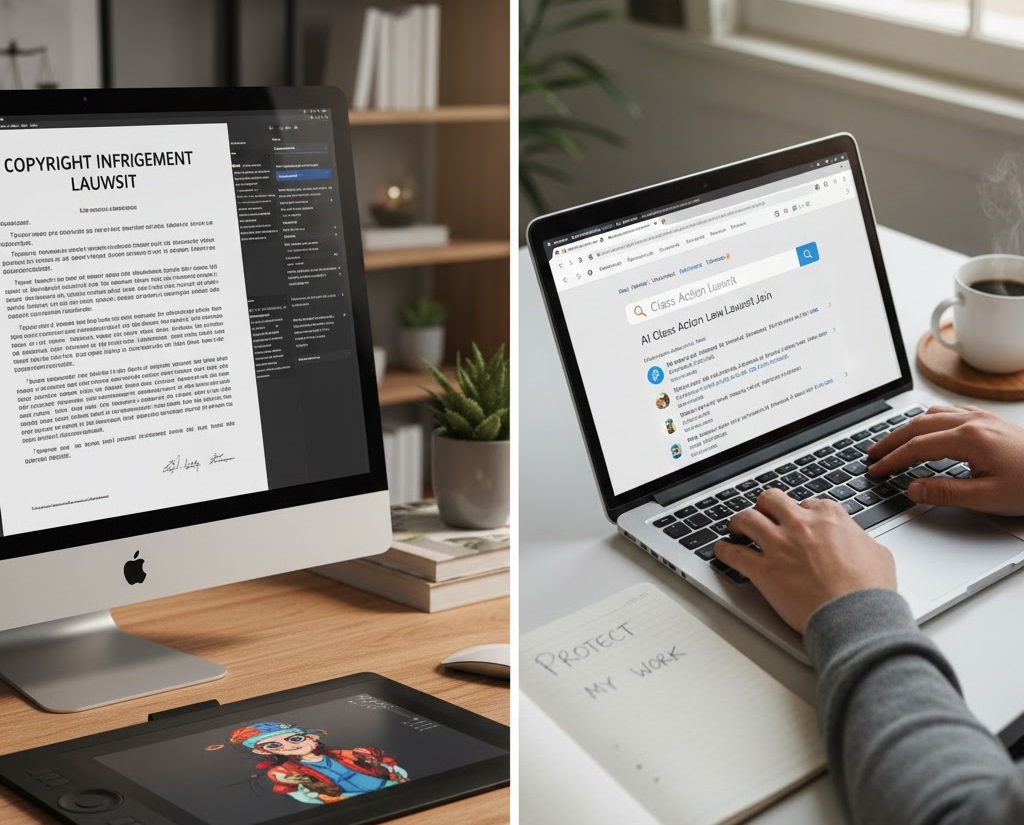
If you are an artist, writer, or photographer, you’ve probably had that sinking feeling: seeing something online that looks suspiciously like your work, but it was “generated” by an AI.
As a creator myself, I spent months researching whether I could actually hold these tech giants accountable. In 2026, the laws are finally catching up, but it’s not as simple as “sending a bill.” Here is what I discovered about the reality of suing AI companies for copyright infringement today.
1. The Big Question: Is it “Fair Use”?
The billion-dollar battleground right now is Fair Use. AI companies argue that they are just “learning” from your work, much like a human student does.
However, in my research and consultations with IP (Intellectual Property) lawyers, the tide is turning. If the AI output is “substantially similar” to your specific work, you might have a case. The courts are now looking at whether the AI is actually replacing your market value.
2. Can You Prove Your Data Was Used?
This was my biggest hurdle. How do you prove a “Black Box” model trained on your specific images or articles?
-
The Transparency Tool: In 2026, new tools allow you to search training datasets (like LAION or Common Crawl) for your digital fingerprint.
-
Opt-Out Failures: If you explicitly used “No AI” tags or opted out, and they still used your work, your legal position becomes much stronger.
3. Individual Lawsuit vs. Class Action
Unless you are a world-famous artist, suing OpenAI or Google individually is nearly impossible due to the legal costs.
Your Legal Options in 2026
| Option | Pros | Cons | My Verdict |
| Individual Lawsuit | High potential payout. | Extremely expensive ($100k+). | Only for high-value creators. |
| Class Action | Zero upfront cost for you. | Payout is usually small ($50-$500). | Best for most people: Strength in numbers. |
| DMCA Takedown | Fast and free. | Doesn’t get you money. | Good for removing specific content. |
| AI Licensing Unions | Recurring passive income. | Requires joining a guild. | The Future: Get paid to be in the dataset. |
4. Step-by-Step: What I Did When I Found My Work
If you suspect your work was used without permission, here is the protocol I followed:
-
Document the Evidence: I took screenshots of the AI generating work that mirrored my style or used my specific characters.
-
Check the “Terms of Service”: Many platforms now have a “Copyright Claim” section. Use it. It creates a paper trail.
-
Consult a Mass Tort Firm: Many U.S. law firms are now specializing in “AI Infringement.” They often offer free consultations to see if you qualify for an ongoing class action.
5. My Final Advice: Protect Your Future Work
Suing for the past is hard, but protecting the future is easier. I’ve started using “poisoning” tools like Nightshade or Glaze on my images. These tools subtly change pixels so that if an AI tries to “learn” from them, it breaks the model’s understanding of the image.
The legal battle over AI is the “Napster moment” of our decade. We might not all get rich from lawsuits, but we are finally setting the rules for the digital age.
Related posts:
 Zero-Day Emergency: Apple Confirms Active WebKit Attacks—All iPhone Users Must Update to iOS 26.2 Now
 From GTA to AI Nightmares: Dan Houser Returns with His Darkest Vision Yet in A Better Paradise
 The Creator Flip: Why This $98 Billion Industry Is Quietly Making Writers Richer Than Musicians
 10 Hidden ChatGPT “Secret Codes” and Prompts That 99% of Users Are Missing