By the Arab Seed News Creative Lab
If you search for “Studio Lighting” on Amazon right now, you’ll be flooded with expensive LED panels, softboxes, and C-stands that cost hundreds of dollars. For a beginner, this is intimidating. I’ve seen many talented creators wait months to start their YouTube channel because they thought they couldn’t afford “pro lighting.”
At the Arab Seed News studio, we have access to high-end lighting rigs, but I’m going to tell you a secret: Your audience doesn’t care how much your lights cost; they only care how the light looks on your face. Today, I’m showing you how we built a “Cinematic” lighting setup for under $50 using items you can find at a local hardware store.
1. The “Work Light” Hero
Instead of buying a dedicated “Photography Light,” we went to a local shop and bought two basic LED Work Lights (the kind construction workers use).
-
The Cost: $15 each.
-
The Catch: These lights are “harsh” and create ugly shadows. But we fixed that with a $2 trick.
2. The “Parchment Paper” Diffusion
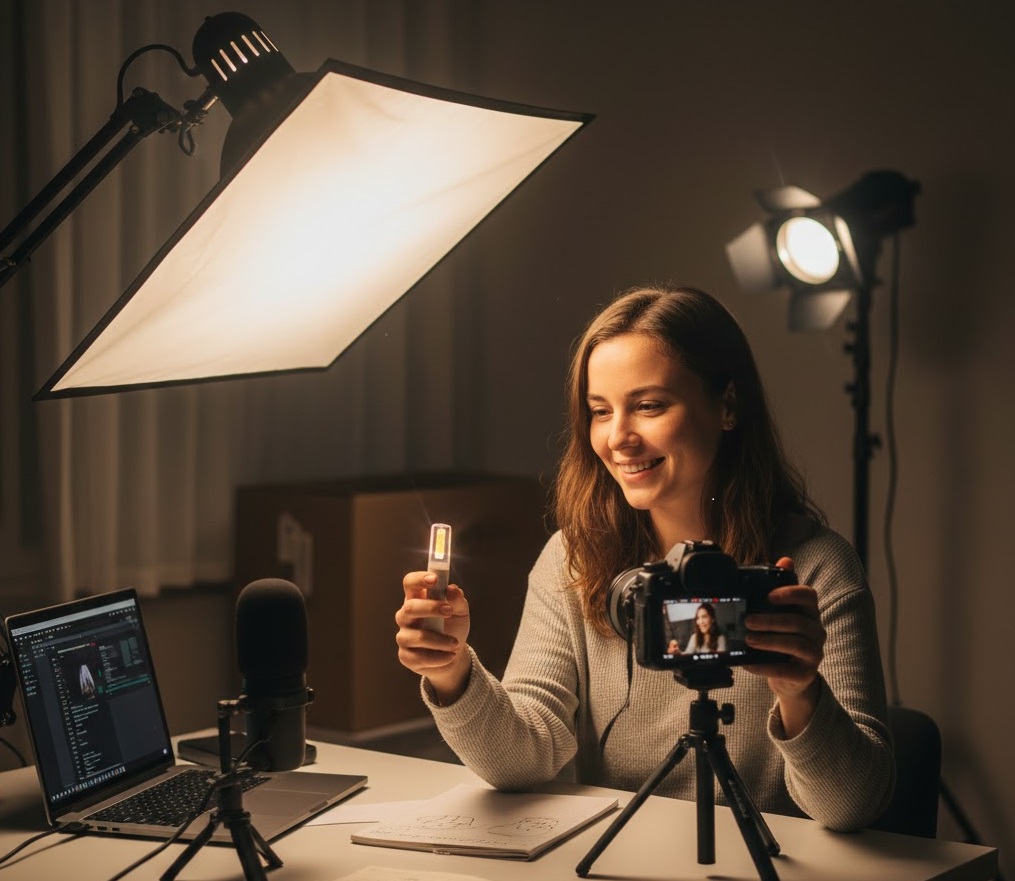
Professional softboxes are just boxes that diffuse light. We achieved the same result by taping Parchment Paper (baking paper) over our work lights. The Human Touch: It sounds ridiculous, but the way baking paper softens the light makes your skin look smooth and professional. Just make sure your LED lights don’t run too hot (LEDs are usually fine, but always be safe!).
3. The 3-Point Lighting Formula (On a Budget)
You don’t need a degree in cinematography to look good. We used our $50 kit to follow the classic 3-point setup:
-
Key Light (The $15 Work Light): Placed at 45 degrees to the face. This is our main light.
-
Fill Light (A White Poster Board): We didn’t even buy a second light. We used a $2 white foam board to reflect the Key Light onto the dark side of the face.
-
Back Light (A Desk Lamp): We took a regular lamp from the bedroom and placed it behind us to create a “halo” effect on our shoulders. This separates you from the background.
4. The “Color Temperature” Trap
The biggest mistake people make with cheap lights is mixing “Yellow” (Warm) light with “Blue” (Daylight). Our Advice: Ensure all your bulbs are the same. We recommend 5600K (Daylight) because it looks the most natural on camera and mixes well with any light coming from your window.
The Verdict: Gear Doesn’t Make the Creator
The most expensive light in the world won’t save a boring video, but a great story told with a $15 work light will always find an audience. Stop waiting for a “pro” budget. Grab some baking paper, a hardware store light, and start shooting.