In our modern world, we are taught that “winning” requires pushing harder, fighting back, and resisting anything that doesn’t go our way. But what if the secret to unshakeable self-confidence isn’t found in the struggle, but in the release?
The Art of Non-Resistance is a powerful psychological and spiritual concept that suggests that by stopping our internal battle against reality, we preserve our energy for growth. When you master this, you don’t become “weak”—you become a force that cannot be broken.
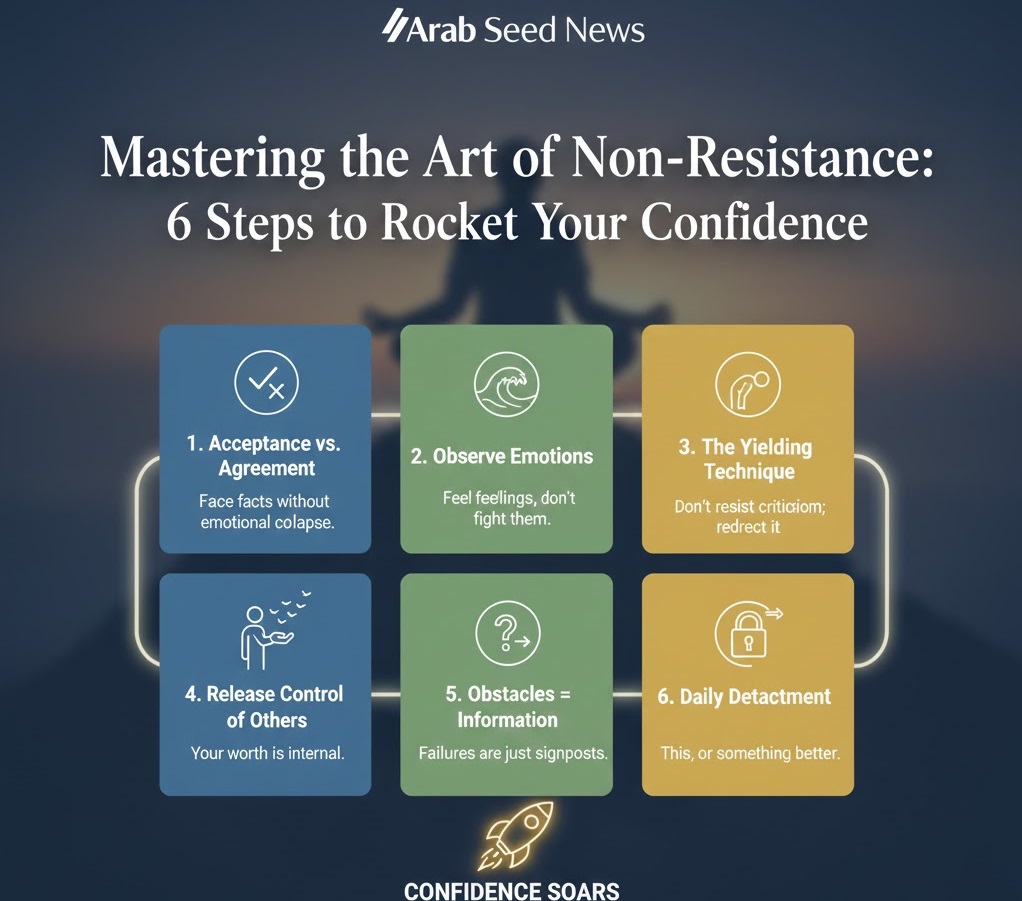
Here are six practical steps to mastering non-resistance and watching your confidence soar.
1. Differentiate Between Acceptance and Agreement
The biggest hurdle to non-resistance is the belief that “accepting” a situation means you “agree” with it. This isn’t true.
-
The Practice: When something goes wrong—a missed promotion or a difficult conversation—acknowledge it as a fact of the present moment.
-
The Result: By stopping the internal “This shouldn’t be happening!” shout, you calm your nervous system. Confidence begins when you can face facts without being emotionally destroyed by them.
2. Observe the “Emotional Wave” Without Reacting
When we resist an emotion (like fear or shame), we actually make it stickier and longer-lasting. This is known as “The Law of Reversed Effort.”
-
The Practice: The next time you feel a surge of anxiety, don’t try to “fix” it immediately. Sit with it. Label it: “I am feeling a wave of rejection right now.”
-
The Result: When you stop resisting your feelings, they pass through you faster. Real confidence comes from knowing you can handle any emotion that arises.
3. Practice “The Yielding Technique” in Conflict
In arguments, our natural instinct is to build a wall of resistance. However, a wall can be knocked down; water, which yields, cannot be.
-
The Practice: If someone criticizes you, instead of a defensive rebuttal, try saying: “That’s an interesting perspective, let me think about that.”
-
The Result: You take the power away from the critic. By not providing a “surface” for them to hit, you remain in total control of your energy. That is the definition of high-level confidence.
4. Release the Need to Control Others
Much of our daily stress comes from resisting the choices and personalities of the people around us. We want them to be different so that we can feel better.
-
The Practice: Practice “letting people be wrong.” Release the urge to correct, change, or manage others’ opinions of you.
-
The Result: You stop outsourcing your self-worth. Your confidence becomes internal and independent of external approval.
5. Reframe “Obstacles” as “Information”
Non-resistance means looking at a “No” or a failure not as a wall, but as a signpost.
-
The Practice: When a door closes, instead of banging your head against it (resistance), ask: “What is this situation telling me about my next move?”
-
The Result: You move from a “Victim Mindset” to a “Learner Mindset.” A confident person isn’t someone who never fails; they are someone who isn’t afraid to pivot.
6. Daily Detachment Exercises
Confidence is often weighed down by “attachment”—the idea that we must have a specific outcome to be happy.
-
The Practice: Set a goal, work hard toward it, but tell yourself: “This, or something better.”
-
The Result: You remove the desperation that kills confidence. When you aren’t desperate for a specific result, you perform better and project a much more attractive, stable energy.
Frequently Asked Questions
Does non-resistance mean I should be a “doormat”?
Absolutely not. Non-resistance is about internal peace, not external passivity. You can still take action, set boundaries, and say “no.” The difference is that you do it from a place of calm clarity rather than angry resistance.
How does this actually increase confidence?
Confidence is essentially a lack of internal conflict. When you stop fighting your environment and your emotions, you stop leaking energy. That “saved” energy naturally manifests as a steady, quiet confidence.
Is this related to “Flow State”?
Yes. You cannot enter a flow state while you are in a state of resistance. Mastery of any skill (including the skill of living) requires a level of “letting go” so that your subconscious can take over.
Final Thoughts: The Power of Letting Go
Mastering the art of non-resistance is a life-long journey, but the rewards are immediate. By following these six steps, you move from a state of constant “friction” to a state of “flow.” Your confidence will rocket because it is no longer dependent on the world being “perfect”—it is based on your ability to remain centered no matter what the world throws at you.
Which area of your life currently feels like it has the most “resistance”? Share your thoughts in the comments, and let’s discuss how to release it!