
In a world filled with constant notifications, endless scrolling, and instant gratification, self-discipline has become a rare superpower. Most people wait for “motivation” to strike before they start working, but those in the top 1% know a secret: Discipline is a muscle, not a feeling.
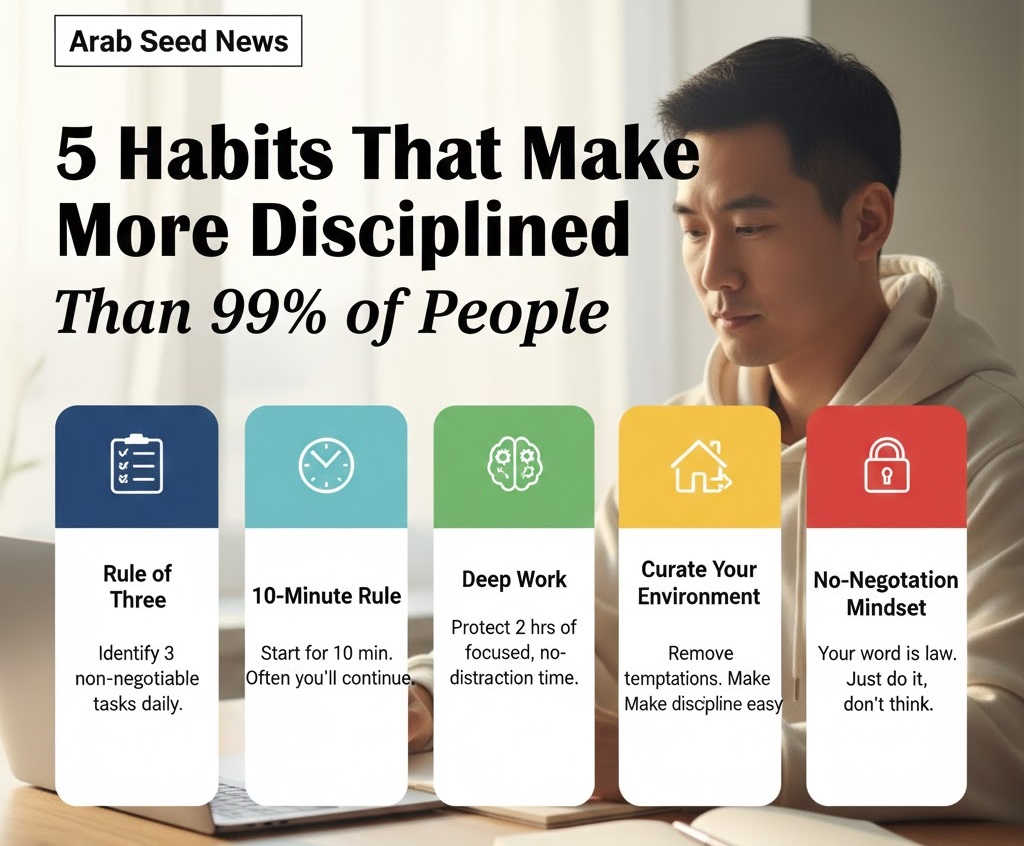
If you want to stop procrastinating and start achieving your long-term goals, you don’t need a personality makeover. You just need to implement the right systems. Here are the 5 habits that will make you more disciplined than 99% of people.
1. The “Rule of Three” for Daily Tasks
Most people fail at discipline because their “To-Do” lists are too long, leading to decision paralysis. Disciplined individuals simplify their focus.
-
The Habit: Every morning (or the night before), identify only three non-negotiable tasks that will move the needle for your life or career.
-
Why it works: By narrowing your focus, you eliminate the mental fatigue of choosing what to do next. When you complete your “Big Three,” you build a winning streak that fuels further discipline.
2. Master the “10-Minute Rule” for Resistance
The hardest part of discipline is the first ten minutes. Whether it’s hitting the gym or writing a report, our brains naturally resist the start of a difficult task.
-
The Habit: Tell yourself, “I will do this task for just 10 minutes. If I want to stop after that, I can.”
-
Why it works: Usually, once you break the initial friction and enter a state of “flow,” you won’t want to stop. Discipline is simply the act of tricking your brain into starting.
3. Prioritize “Deep Work” Over “Busy Work”
Average people spend their day reacting—responding to emails, checking Slack, and attending meetings. Disciplined people protect their peak cognitive hours.
-
The Habit: Schedule a 2-hour block of “Deep Work” during your most productive time (usually early morning) where your phone is in another room and all tabs are closed.
-
Why it works: You can achieve more in two hours of focused, undisrupted work than most people do in an entire eight-hour day of “shallow” work.
4. Curate Your Environment to Minimize Willpower
Disciplined people don’t actually have “stronger” willpower; they just use it less often. They design their environment so they don’t have to fight temptation.
-
The Habit: If you want to eat healthily, don’t keep junk food in the house. If you want to work, put your phone in a drawer.
-
Why it works: Willpower is a finite resource. If you have to fight your environment all day, you will eventually lose. Designing your surroundings makes discipline the “path of least resistance.”
5. Embrace the “No-Negotiation” Mindset
Discipline dies in the “should I or shouldn’t I” phase. When you negotiate with yourself (e.g., “Maybe I’ll work out tomorrow instead”), you’ve already lost.
-
The Habit: Treat your habits like an appointment with a boss you can’t fire. When the alarm goes off, you get up. When the schedule says “write,” you write.
-
Why it works: By removing the option to negotiate, you save mental energy. Discipline becomes an identity (“I am the type of person who does this”) rather than a daily struggle.
Common Questions: Mastering Self-Discipline
Is discipline something you are born with?
Absolutely not. While some temperaments may find it easier, discipline is a learned behavior. It is built through small, consistent wins rather than giant leaps.
How long does it take to build these habits?
Research suggests it takes anywhere from 18 to 66 days to form a new habit. The key isn’t being perfect; it’s being consistent. If you miss a day, don’t miss two.
What is the difference between discipline and motivation?
Motivation is a feeling that comes and goes based on your mood. Discipline is a system that keeps you going when your mood is low. Discipline eats motivation for breakfast.
Final Thoughts: The Discipline Gap
The gap between who you are and who you want to be is called consistency. By adopting these five habits, you aren’t just getting more work done; you are training your brain to trust your own word. When you say you are going to do something and you actually do it, you become unstoppable.
Which of these habits are you going to start tomorrow? Let us know in the comments—committing publicly is the first step toward discipline!