
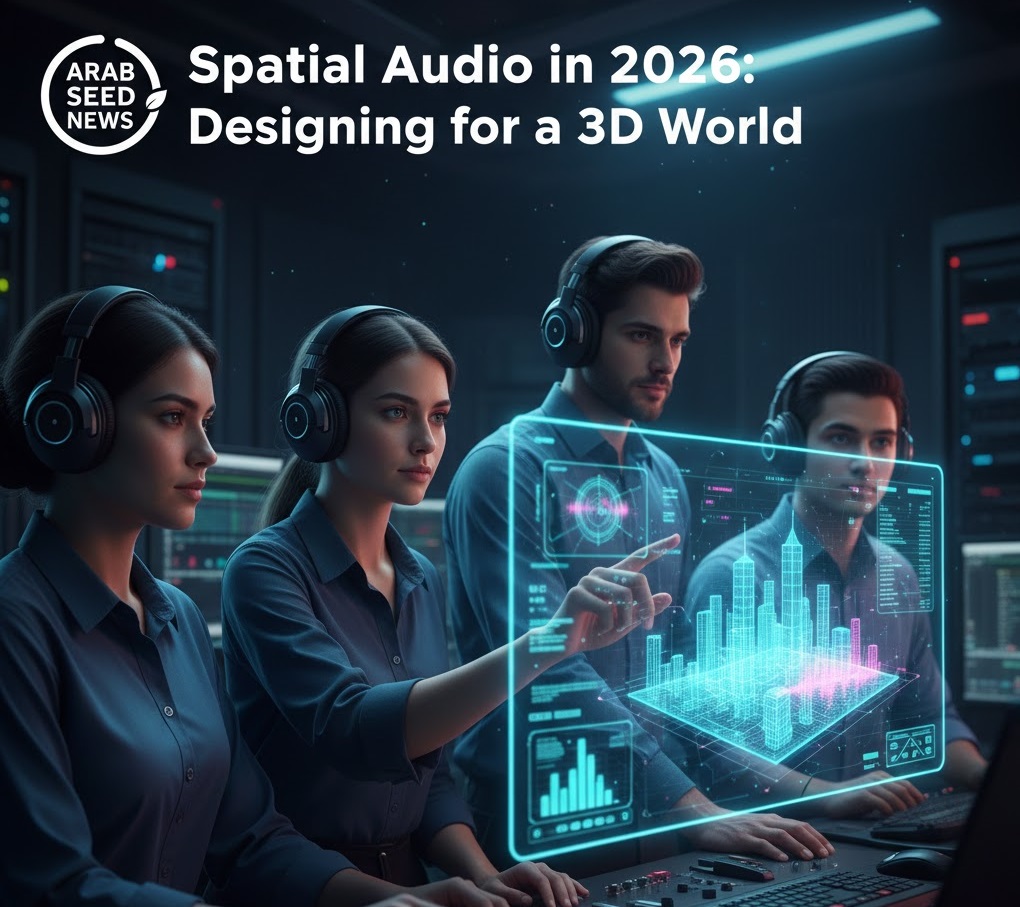
The Day the World Expanded
I’ve always considered myself a “Stereo Purist.” I grew up believing that two channels—left and right—were all you needed to create a convincing soundstage. But everything changed during a late-night session in 2025. I was testing a new binaural mix on a pair of high-end spatial-aware headphones, and for the first time, I heard a sound move not just between my ears, but behind my neck and above my forehead. It was a visceral, almost ghostly experience. It made me realize that traditional stereo is like looking at a painting, while Spatial Audio is like walking into a room. At Arab Seed News, we’ve moved from “making videos” to “building environments.”
Understanding the Science: Beyond Surround Sound
To master Spatial Audio in 2026, you have to understand that it is fundamentally different from the old “5.1 Surround Sound” we used in home theaters. Surround sound is Channel-Based—it sends audio to specific speakers. Spatial Audio is Object-Based.
In a spatial mix, you aren’t sending sound to a “left rear speaker.” Instead, you are placing a “Sound Object” in a 3D coordinate system (X, Y, Z). The listener’s playback device (whether it’s a VR headset, AirPods, or a smart speaker) then calculates how that sound should reach their ears based on their head position. This is handled by HRTF (Head-Related Transfer Function)—a mathematical model of how our ears, head, and shoulders affect the way we perceive sound coming from different directions.
Why 2026 is the Year of 3D Audio
With the massive adoption of wearable tech and mixed reality, the demand for immersive audio has skyrocketed. If you are a video producer and you are still only mixing in stereo, you are leaving 50% of the emotional impact on the table. Spatial audio mimics how we experience the real world, which drastically increases Viewer Retention. When a viewer feels the environment, they stay longer.
How-to: Crafting an Immersive Mix in Your Home Studio
You don’t need a multi-million dollar setup to start creating spatial content. Here is how I do it:
-
Use an Ambisonic Microphone: When you are on location, don’t just record a mono voiceover. Use an Ambisonic mic (like the Zoom H3-VR) to capture the “atmosphere” of the space in four channels. This captures the height and depth of the room.
-
The “AmbiX” Plugin Workflow: Load your audio into a DAW (like Reaper or DaVinci Resolve’s Fairlight). Use the AmbiX plugin suite to convert your tracks into “B-Format.” This allows you to pan sounds in a sphere around the listener.
-
Mixing the “Bed” vs. “Objects”: Keep your music and atmosphere in the “Bed” (the general environment), but treat your sound effects (footsteps, passing cars, whispers) as “Objects.” Use the spatial panner to automate their movement.
-
Binaural Monitoring: Since 90% of your audience will experience this through headphones, always monitor your mix in Binaural Mode. This simulates the 3D effect through standard stereo speakers.
The Pro Tip: Don’t overdo it. Just because you can make a sound spin around the listener’s head doesn’t mean you should. Use spatial cues to support the story. If a character is looking left, place their voice slightly to the left. Subtlety is what makes a mix professional.


More Stories
Forensic Audio Repair: Saving “Unusable” Audio Without AI Artifacts
Mastering the Vocal Chain: My Step-by-Step Plugin Guide
Why Your High-End Mic Sounds Terrible (and How to Fix It Today)