
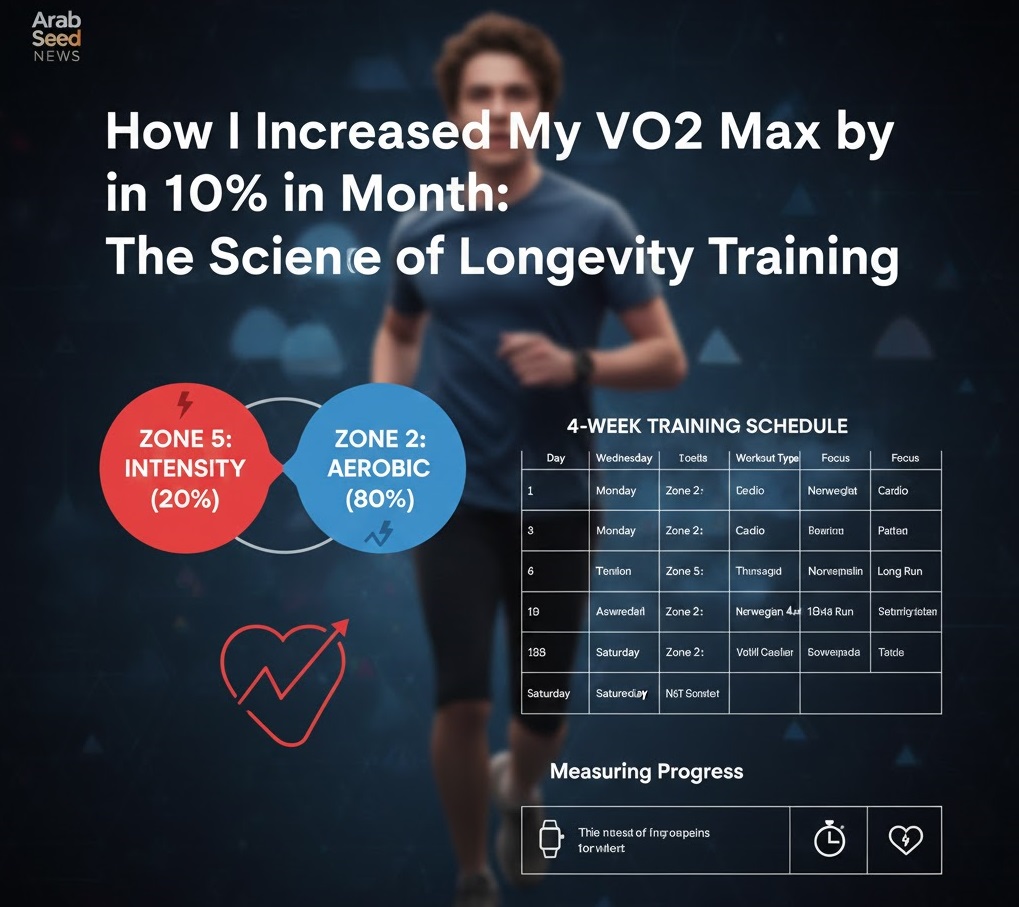
If you follow health experts like Dr. Peter Attia or listen to the Huberman Lab, you’ve likely heard one metric mentioned more than any other: VO2 Max.
Recent studies suggest that VO2 Max is perhaps the single most powerful predictor of how long you will live (longevity) and how well you will live (healthspan). Unlike many “hacks,” improving your VO2 Max requires a specific, science-backed approach.
I decided to put the theory to the test. By following a structured 4-week protocol, I managed to increase my VO2 Max by 10%. Here is the “No BS” breakdown of how I did it, the science behind it, and how you can do it too.
Why VO2 Max is the “Holy Grail” of Longevity
VO2 Max is the maximum amount of oxygen your body can utilize during intense exercise. Think of it as the size of your “engine.”
A higher VO2 Max doesn’t just mean you’re faster on a treadmill; it means your heart, lungs, and mitochondria are working with peak efficiency. According to research published in JAMA Network Open, being in the “elite” category of VO2 Max is associated with an 80% reduction in mortality risk compared to those in the lowest category.
The 80/20 Protocol: How I Trained
To move the needle in just 30 days, I couldn’t just “jog.” I had to balance two very different types of training: Zone 2 (Aerobic Base) and Zone 5 (Peak Output).
1. The Foundation: Zone 2 Training (80%)
Zone 2 is steady-state exercise at a pace where you can still hold a conversation, but it’s slightly uncomfortable.
-
The Goal: Build mitochondrial density and efficiency.
-
My Routine: Three sessions per week, 45 to 60 minutes each (Cycling or brisk incline walking).
2. The Engine Booster: The Norwegian 4×4 (20%)
This is where the magic—and the pain—happens. The Norwegian 4×4 protocol is widely considered the “gold standard” for increasing VO2 Max quickly.
-
-
The Protocol: * 4 minutes of high-intensity effort (90% of max heart rate).
-
3 minutes of active recovery (slow walking or light pedaling).
-
Repeat 4 times.
-
-
My Routine: One session per week.
-
My 4-Week Training Schedule
| Day | Workout Type | Focus |
| Monday | Zone 2 | 45-60 mins steady cardio |
| Tuesday | Rest/Walk | Active recovery |
| Wednesday | Zone 5 | Norwegian 4×4 Intervals |
| Thursday | Zone 2 | 45-60 mins steady cardio |
| Friday | Strength | Lower body/Compound movements |
| Saturday | Zone 2 | Long session (60-90 mins) |
| Sunday | Rest | Full recovery |
Measuring Progress: How Do You Know It’s Working?
You don’t need a lab to track your VO2 Max. While “Gold Standard” metabolic cart tests are the most accurate, you can get a very good estimate using:
-
Wearables: Apple Watch, Garmin, and Whoop provide surprisingly accurate estimates based on your heart rate and pace.
-
The Cooper Test: See how far you can run in 12 minutes and use an online calculator.
-
Recovery Heart Rate: Watch how quickly your heart rate drops in the first minute after a Zone 5 interval.
3 Critical Tips for Success
-
Don’t Skip the Recovery: VO2 Max training is taxing on the central nervous system. I focused on getting 8 hours of sleep and high protein intake to repair the heart muscle and legs.
-
Consistency Over Intensity: One missed week resets your progress. It’s better to do a “bad” 20-minute Zone 2 session than nothing at all.
-
Check with a Doctor: Since VO2 Max training involves pushing your heart to its limits, ensure you are cleared for high-intensity exercise.
Final Thoughts: Was it Worth It?
A 10% jump in 30 days felt incredible. Beyond the numbers, I noticed more energy during the day, better sleep quality, and a significantly lower resting heart rate (it dropped from 62 to 56 bpm).
Improving your VO2 Max is the best “insurance policy” you can buy for your future self. It’s not about being an athlete; it’s about making sure your 80-year-old self can still hike, play with grandkids, and live independently.
Are you ready to test your engine? Tell me your current VO2 Max score in the comments, and let’s see if we can get it higher!