
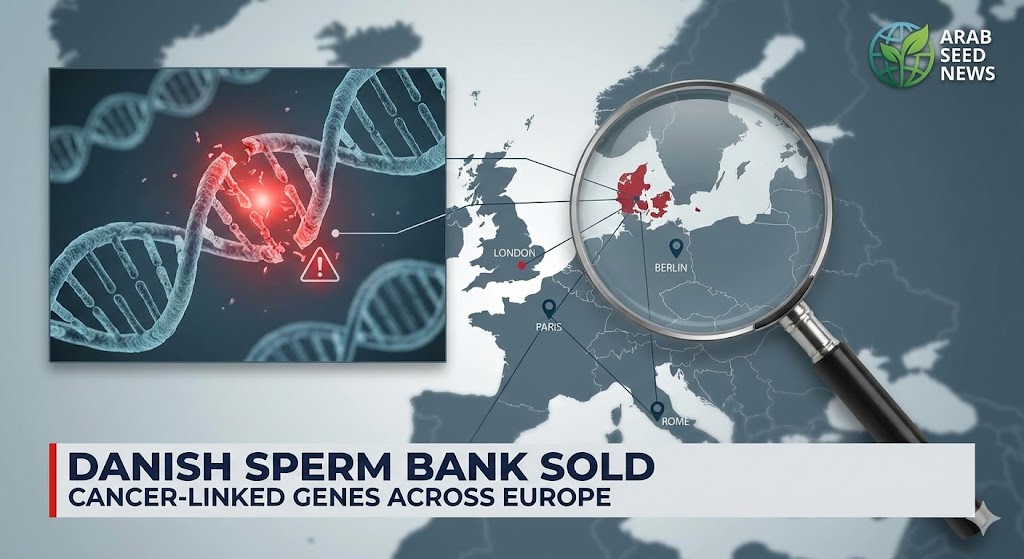
In 2023, a prolific donor to a Danish sperm bank was found to carry a genetic mutation that can contribute to childhood cancers. An investigation by DW and European partners has found that some parents were never warned.
The Shock of the Phone Call: The Beginning of a Scary Medical Journey
One morning in June, when the woman’s phone rang, she did not know that the news she would receive would hurtle her and her teenage daughter into a “tunnel” of medical appointments, tests, and fear.
On the other end of the line, said the woman, who asked to remain anonymous, was the head of the fertility department at a Belgian clinic she had visited in 2011 to undergo fertility treatment, which at the time was not available to would-be single mothers in France. After her daughter was successfully conceived, she said, she had never heard from the clinic again.
The caller told her that the sperm donor she had used to conceive her daughter carried a rare genetic mutation of the TP53 gene, which suppresses cancerous growth. The mutation is linked to a heightened and lifelong risk of multiple cancers — many of which can develop at a very early age. The caller said her daughter had a 50% chance of inheriting the mutation, for which there is no cure. It was, she was told, “urgent” for her to screen her daughter for the mutation.
“It was a shock,” said the woman. “I didn’t understand anything.”
She would soon learn that her daughter did indeed carry the genetic mutation.
In fact, after the mutation was detected in his samples, the donor had been permanently blocked in October 2023 by the European Sperm Bank (ESB), which had sold the sperm. Though the clinic maintains that it contacted the woman “as soon as possible,” it told her she received the call a year and a half after the ESB discovered the mutation because it had migrated its computer system and initially lost her contact details.
Donor 7069: The Spread of the Genetic Mutation Across Europe
Coordinated by the EBU Investigative Journalism Network, an investigation by DW and several other European public broadcasters reveals that, for more than 15 years, women in at least 14 countries in Europe and elsewhere were sold sperm from donor 7069.
From Iceland to Albania and beyond, at least 197 children were conceived with donor 7069’s sperm, the investigation shows. It is possible that the number is far higher — the ESB has yet to disclose the total number of children conceived with his sperm. And so doctors are unable to say whether all of them have even been tested at this point.
Thus, a rare and potentially fatal genetic mutation was sold to families across Europe.
Some of the donor-conceived children have already developed two different sorts of cancer; others “have already died,” said Edwige Kasper, a biologist who specializes in genetic predispositions to cancer. She is counseling some of the affected families.
Legally, the sperm bank has the obligation to alert all fertility clinics to which it exported gametes of any genetic abnormalities that arise. The clinics, in turn, inform parents.
And yet DW and its partners have learned of several cases of families who were never officially informed that their children might be carriers.
“A Big Frustration”: Parents Discover the Truth
Dorte Kellermann, a single mother who lives in Denmark, said she learned about the case in November 2023 from another parent who had used the donor. She told DW and its partners that she had not been contacted by either the sperm bank or the fertility clinic she had used. And, she said, she was aware of other families — single mothers who had used the same donor, and who had connected via a private Facebook group. The former director of the clinic Kellermann had used said he could not comment on individual cases.
Though DW is unable to verify each of the Facebook group’s accounts, they are consistent with those of doctors and reports issued by health authorities across Europe.
Dr. Svetlana Lagercrantz, who specializes in hereditary cancers, told the Danish Broadcasting Corporation, one of DW’s partners in the investigation, that several of her patients in Sweden had never been contacted. She said they had only found out about the mutation through media reports. It was, she said, “a big frustration.”
The Extent of the Problem Becomes Clear to Doctors
It took a gathering of hereditary cancer experts in 2024 to realize the extent of the problem. Lagercrantz said a French colleague was talking about patients who had inherited the TP53 mutation from their sperm donor.
Suddenly, she said, doctors from across Europe realized that what they had assumed were singular cases were in fact all fathered by one single donor — spanning the continent and even beyond.
It left her “shaken.”
Lifelong Screening: The Challenge Ahead for Families
Citing privacy concerns, the ES
Related posts:
 A Deep Dive into America’s Newborn Hepatitis B Vaccine Controversy: Politics, Science, and a Nation Divided
 Pregnancy Testing Isn’t Enough: Doctors Warn Against Eroding Newborn Protection After ACIP’s Hepatitis B Vaccine Decision
 Alarming Spread: Over 250 Quarantined in South Carolina as Measles Outbreak Rages
 Pediatricians Defy New CDC Panel Guidance, Commit to Universal Hepatitis B Shots for Newborns