
By: Arab Seed News Editorial Team
For many years, psychiatry has relied on rigid diagnostic manuals that separate mental disorders as if they were isolated islands: depression on one side, anxiety on another, and autism on a completely different path. But a massive genetic study involving more than one million people has turned this notion upside down, revealing a remarkable truth: most of these disorders share common biological roots far deeper than previously believed.
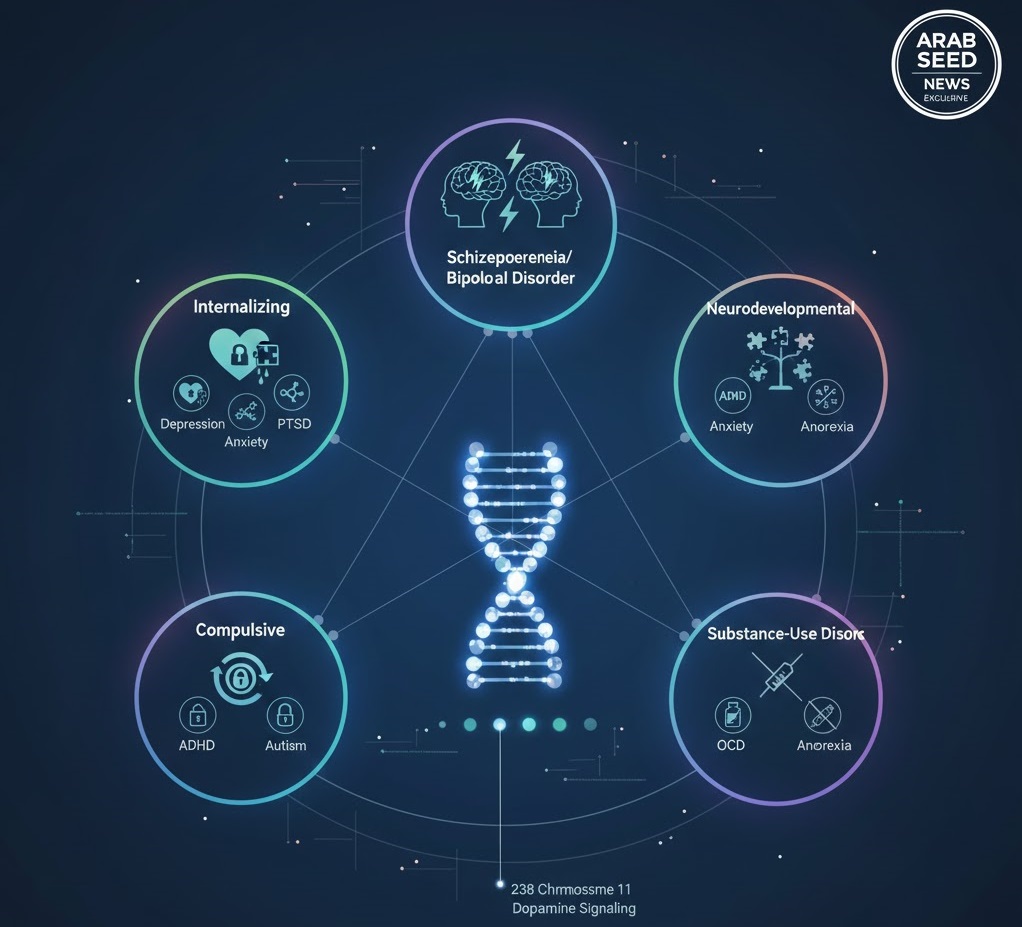
The study, published in the prestigious journal Nature, shows that people suffering from seemingly unrelated disorders actually share the same genetic mutations linked to these conditions. Through an unprecedented large-scale analysis, researchers were able to reclassify 14 mental disorders into five main groups based on shared genetic risk factors. These findings call for a rethinking of how we understand, diagnose, and treat mental health conditions.
Andrew Grotzinger, co-author of the study and behavioral geneticist at the University of Colorado Boulder, says:
“You can see the frustration on a patient’s face when they receive five different diagnoses instead of one that truly reflects their condition.”
The study does not only provide a new scientific framework — it also opens a door of hope for both patients and clinicians.
First: Why do mental disorders overlap this way?
The driving force behind this massive scientific project is a phenomenon well known to doctors: diagnostic overlap, or comorbidity. Most individuals diagnosed with depression, for example, often end up receiving a second diagnosis such as generalized anxiety disorder.
To uncover the true link between these conditions, researchers analyzed the genetic data of a huge number of patients and compared it with millions of healthy individuals. This unprecedented dataset allowed, for the first time, a deep tracing of the biological structure underlying mental health disorders.
Second: Five new genetic groups redefining psychiatry
Instead of treating 14 disorders as separate conditions, the researchers categorized them into five genetically related groups. Each disorder belongs to a cluster that shares the same genetic foundation:
-
Schizophrenia / Bipolar Disorder Group
Sharing genetic pathways that affect mood and cognition. -
Internalizing Disorders Group
Includes depression, anxiety, and PTSD — disorders that attack the emotional interior. -
Neurodevelopmental Disorders Group
Includes autism and ADHD — conditions with early developmental origins. -
Compulsive Disorders Group
Such as OCD and anorexia nervosa, marked by intrusive thoughts and repetitive behaviors. -
Addiction Disorders Group
Related to alcohol, nicotine, and other substance dependencies.
Third: 238 genetic regions that could transform psychiatric medication
The study didn’t stop at classification; researchers also identified 238 genetic loci directly linked to these five groups. These regions represent golden targets for developing medications that treat the root causes rather than just the symptoms.
One of the most prominent regions appears on chromosome 11, increasing the risk of eight different disorders because it affects the dopamine system — the pathway responsible for motivation and reward.
Fourth: What does this mean for the future?
The findings suggest that we may be viewing mental disorders in a far more fragmented way than necessary. Many current diagnostic labels might simply be different expressions of a smaller number of deeper conditions.
Benefits for patients:
-
Fewer overlapping diagnoses causing confusion and emotional burden
-
A clearer understanding of their condition rather than multiple conflicting labels
Benefits for clinicians and scientists:
-
Medication development can be directed toward shared genes rather than treating each disorder separately
-
Faster progress toward more effective, biology-based treatments
Conclusion
This study represents a historic turning point in our understanding of mental disorders. For the first time, we have a “genetic map” linking these conditions together, pushing us toward a more precise, humane, and effective form of psychiatry.
Related posts:
 Fact-Checking Trump’s Prime-Time Address: Reality vs. Rhetoric on the Economy, Immigration, and the ‘Warrior Dividend’
 Pediatricians Defy New CDC Panel Guidance, Commit to Universal Hepatitis B Shots for Newborns
 Pregnancy Testing Isn’t Enough: Doctors Warn Against Eroding Newborn Protection After ACIP’s Hepatitis B Vaccine Decision
 Alarming Spread: Over 250 Quarantined in South Carolina as Measles Outbreak Rages