
By the Arab Seed News Investigative Team
It happened again this morning in our editing suite. We were working on a high-stakes commercial project using the latest AI video generators, hoping for that “perfect” shot of a pianist. On the small screen, it looked majestic—until we zoomed in. There it was: a nightmare of seventh fingers melting into the ebony keys like something out of a 1980s body-horror flick.
In the industry, we dismissively call these “AI Artifacts,” but for a professional creator in 2026, they are the single biggest hurdle to making AI video truly “broadcast-ready.” Even with the massive computational power behind Sora 2 or Kling, the “Hand Problem” remains the final, stubborn frontier.
The Physics of a Finger: Why Data Isn’t Enough
Why can an AI simulate a crumbling skyscraper or a swirling galaxy with ease, yet fail at drawing five simple fingers? After months of testing at Arab Seed News, the answer became clear: AI doesn’t actually know what a hand is. To a machine, a hand is just a statistical probability of pixels based on millions of training images. It sees fingers near palms, but it lacks a fundamental understanding of skeletal physics. When a hand rotates, fingers overlap and occlude each other. The AI gets “confused” about which finger belongs to which joint, leading to that nauseating “melting” effect. It’s not a lack of data; it’s a lack of structural logic.
The “Interactivity” Wall
We’ve noticed a pattern in our latest “Stress Tests.” An AI-generated hand looks great when it’s just resting on a table. The moment that hand has to interact—shuffling a deck of cards, tying a shoelace, or gripping a coffee mug—the logic shatters.
The AI has to calculate not just the movement, but the pressure of the skin, the shifting shadows between the fingers, and the reflections on the object. Currently, the “contextual awareness” of even the most expensive GPUs isn’t fast enough to maintain that level of detail across 24 frames per second.
Inside the Editor’s Toolbelt: “Hiding” the Glitch
So, how do we at Arab Seed News deliver AI projects to clients without them noticing these flaws? We stop being “prompters” and start being “directors.” Here are the three “smoke and mirrors” tricks we use every day:
-
The Strategic Crop (MCU): If the hands are failing, we don’t use the shot. We crop into a Medium Close-Up (MCU) focused on the face or shoulders. If the audience doesn’t see the fingers, the glitch doesn’t exist.
-
The Motion Blur Hack: We often add a layer of directional motion blur in post-production. By simulating a faster camera shutter, we can effectively “mask” the flickering of AI artifacts during quick hand movements.
-
The Hybrid Approach: This is our secret weapon for 2026. we use AI for the vast, cinematic wide shots, but we film a real human hand in our studio for the close-up action shots. Mixing real “analog” footage with AI “digital” backgrounds creates a seamless, high-end look that is 100% believable.
Final Thoughts: The Soul in the Machine
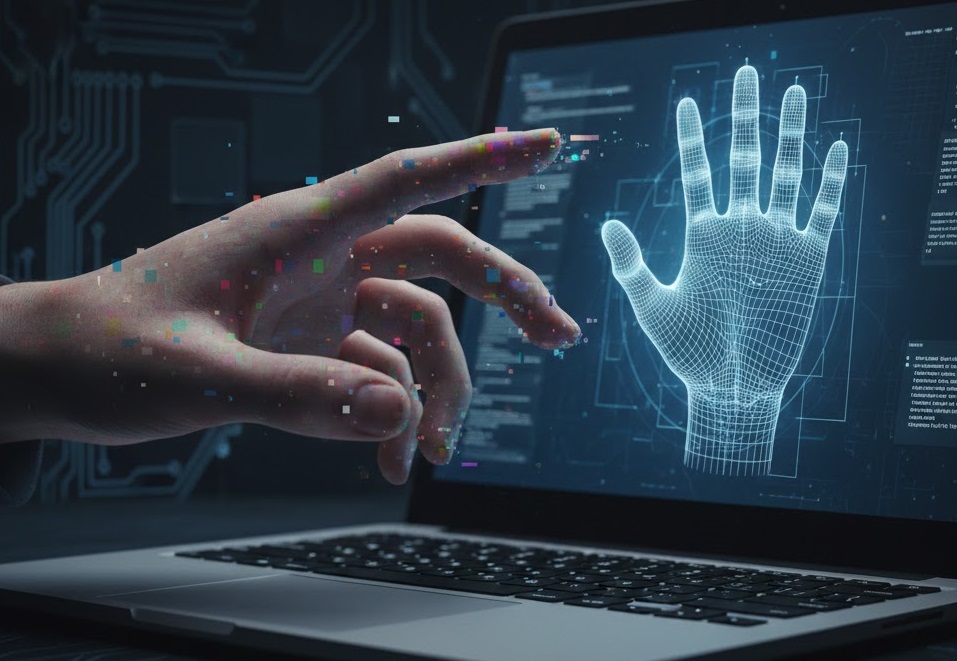
We are seeing progress with “Mesh-Guided” AI, where the software builds a 3D digital skeleton before adding the “skin.” It’s promising, but for now, the “Glitchy Finger” is a humble reminder that human anatomy is a masterpiece of complexity.
Our Verdict: Don’t let a bad hand ruin a good story. As an editor, your job is to curate, hide the flaws, and lead the viewer’s eye. Remember, the audience cares about the emotion of the scene, not the pixel count of a fingernail.