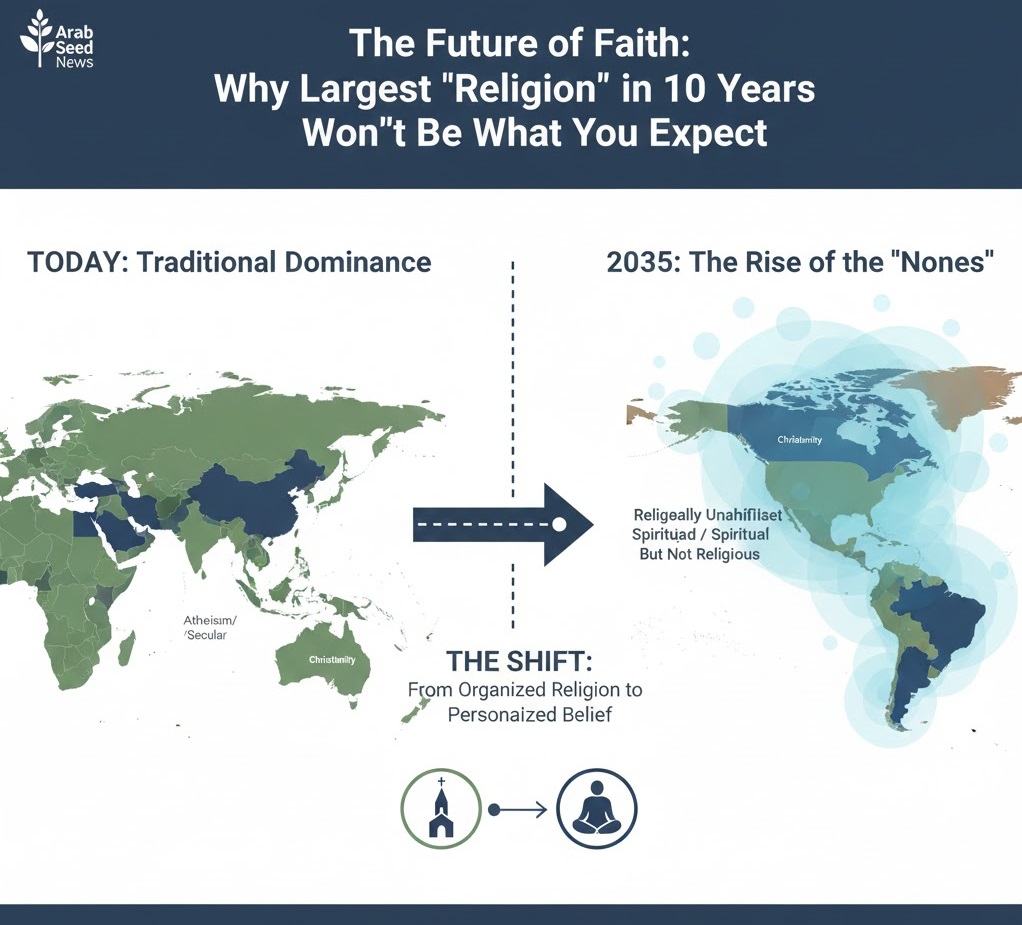
For decades, sociologists and theologians have debated the future of global belief. When we look at the data today, we often see a battle for the top spot between Islam and Christianity, with Atheism growing in the West. People frequently search for “fastest-growing religion in the world” or “religion in 2035.”
However, if we look at current sociological shifts, the “largest” group in a decade won’t be defined by a traditional house of worship. Instead, it will be the rise of the “Religiously Unaffiliated”—often called the “Nones.”
1. The Rise of the “Nones” (Spirituality Without Religion)
A major trend in global demographics is the move away from organized structures. While many people still believe in a higher power, they are increasingly identifying as “Spiritual but not Religious.”
-
The Shift: People are seeking connection and meaning without the baggage of institutional dogma.
-
The Data: In many developed nations, the number of people checking “None” on census forms is skyrocketing. By 2035, this group is expected to be a dominant cultural force.
-
SEO Insight: Search queries for “finding meaning without religion” and “secular spirituality” are at an all-time high.
2. Why Traditional Labels are Fading
Why is this happening? It’s not necessarily that people are becoming atheists. Rather, we are seeing the “Personalization of Faith.”
-
Digital Connectivity: The internet has allowed people to “curate” their own beliefs, blending elements of mindfulness, ancient philosophy, and modern ethics.
-
Trust in Institutions: Global trust in large organizations—whether political or religious—has declined. This drives individuals toward personal, decentralized belief systems.
3. The “New Religions” of the 21st Century
Some experts argue that while traditional religion is declining, “secular religions” are taking their place.
-
Wellness and Biohacking: For many, the gym or the yoga studio has become their temple.
-
Environmentalism: A deep, spiritual commitment to saving the planet is becoming the primary moral compass for millions of young people.
-
The Asset: These groups provide the same community and purpose that traditional religions once did, but under a secular banner.
Frequently Asked Questions (FAQs)
Is Christianity still the world’s largest religion? Currently, yes. However, while Christianity is growing rapidly in Africa and Asia, it is seeing a sharp decline in Europe and North America, leading to a global rebalancing of the faith.
Will Islam become the largest religion soon? Projections suggest that due to birth rates and demographics, Islam may become the world’s largest traditional religion by the late 21st century. However, in the next 10 years, the growth of the “Unaffiliated” remains the most disruptive trend.
Does being “Unaffiliated” mean being an Atheist? No. Most “Nones” believe in something—whether it’s a “universal energy,” “fate,” or “the human spirit.” They simply choose not to belong to a formal religious organization.
Conclusion: A Change in How We Belong
In 10 years, the world won’t be less “faithful”—it will just be less “organized.” The dominant group will be those who prioritize individual experience over collective doctrine. We are moving from a world of “belonging and then believing” to a world of “believing and then finding where you belong.”
How do you see the future of faith? Do you think humanity is becoming more spiritual or more secular? Let’s start a conversation in the comments!