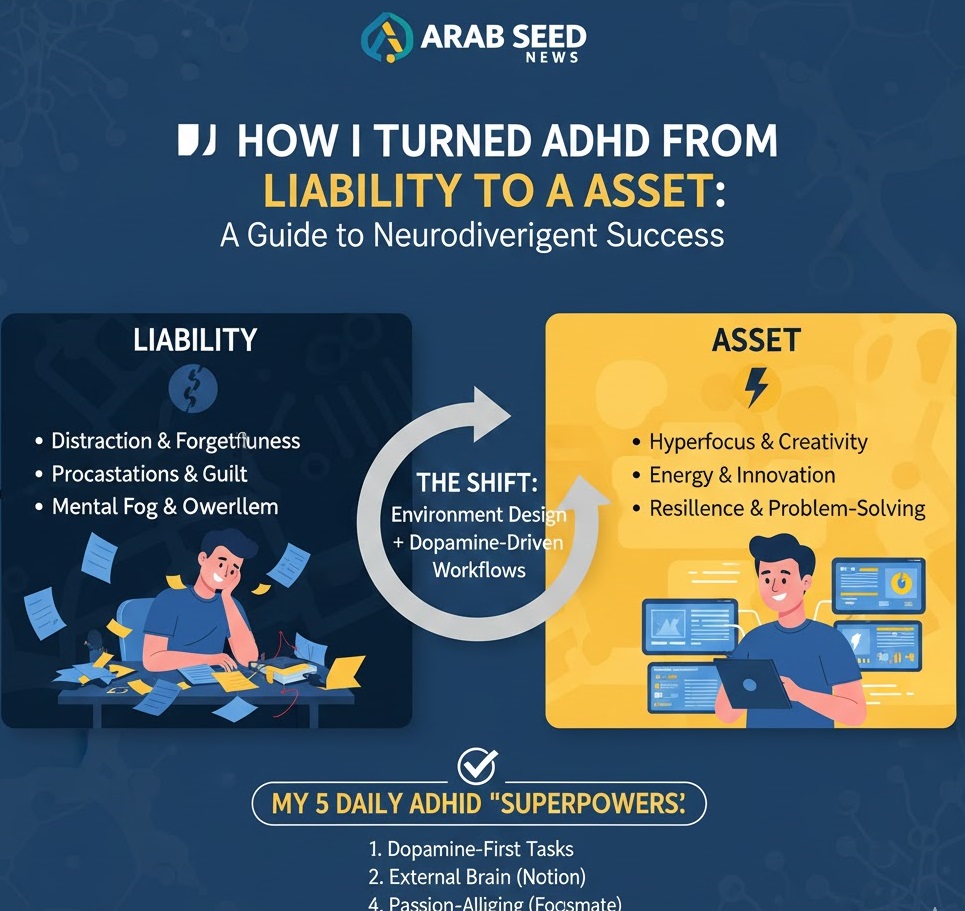
For a long time, I viewed my ADHD (Attention Deficit Hyperactivity Disorder) as a “glitch” in my system. I lived in a cycle of forgotten deadlines, “doom-piling” laundry, and a brain that felt like a browser with 100 tabs open—all playing different music. I spent years searching for “how to be normal” or “how to fix ADHD laziness.”
The breakthrough came when I realized that ADHD isn’t a deficit of attention, but an abundance of it. I didn’t need to fix my brain; I needed to change the “operating system” I was using to run it.
If you are looking for ADHD success stories or practical neurodivergent productivity hacks, here is exactly how I flipped the script.
1. Transforming Hyperfocus into a Competitive Advantage
The world sees ADHD as “distractibility.” What they don’t see is Hyperfocus. When an ADHD brain finds something it’s genuinely curious about, it enters a state of deep work that neurotypical brains often struggle to match.
-
The Shift: I stopped forcing myself to do “important” tasks that bored me and started gamifying them or linking them to my passions.
-
The Asset: In my career, I now use hyperfocus to solve complex problems in two hours that used to take me a week of “trying to be productive.”
2. Managing “Executive Dysfunction” with Dopamine-First Workflows
Many people search for “ADHD executive function tips” because they struggle to start tasks. This isn’t a lack of willpower; it’s a lack of dopamine.
-
The Hack: I ditched the “Eat the Frog” (doing the hardest task first) method. For an ADHD brain, that “frog” is a wall.
-
The Strategy: I start with a “Dopamine Snack”—a 10-minute task I actually enjoy. This sparks the chemical momentum I need to slide into the harder work.
3. The “External Brain” System
My working memory is notoriously short. Trying to hold a to-do list in my head was a liability that caused constant anxiety.
-
The Solution: I built a “Second Brain.” I use digital tools (like Notion or physical whiteboards) to externalize everything.
-
The Asset: Because I don’t use my brain for storage, I use it for processing. This has made me the “ideas person” in my circle, as my mind is free to make creative connections others miss.
4. Embracing “Body Doubling” for Focus
One of the most searched ADHD life hacks is Body Doubling. It’s the simple act of working while someone else is present (even virtually).
-
Why it works: It provides a “social anchor” that keeps the ADHD mind from drifting into a distraction loop. I now schedule “focus sessions” with friends, turning my social nature into a productivity engine.
Frequently Asked Questions (FAQs)
Can ADHD actually be a “superpower”? While “superpower” can feel like an oversimplification of a difficult condition, the traits associated with ADHD—like out-of-the-box thinking, crisis resilience, and high energy—are massive assets in entrepreneurship and creative fields.
What are the best career paths for ADHD adults? Careers that offer novelty, urgency, and autonomy usually rank highest. This includes fields like emergency medicine, sales, software development, and the arts.
How do I stop the “ADHD burnout” cycle? Burnout happens when you try to mask your symptoms and work like a neurotypical person. The key is restoration over stimulation. Scheduled downtime is not a luxury; it’s a biological necessity for our brains.
Conclusion: Your Brain is Not Broken
Turning ADHD from a liability into an asset is about Environment Design. It’s about building a life that fits your brain, rather than trying to shrink your brain to fit a standard life. When you stop fighting your nature, you start finding your genius.
Are you struggling with a specific “ADHD tax” or challenge? Drop a comment below—let’s brainstorm a way to turn it into your next asset!