For years, I viewed my ADHD (Attention Deficit Hyperactivity Disorder) as a “broken” part of my brain. I struggled with forgotten deadlines, the dreaded “mental fog,” and a desk that looked like a paper cyclone hit it. I was constantly searching for “how to be productive with ADHD” only to find advice that worked for neurotypical brains but left me feeling like a failure.
However, everything changed when I stopped trying to “fix” my brain and started trying to understand it. Today, I don’t just manage my ADHD; I use it as a competitive advantage.
If you are looking for ADHD success stories or practical ADHD productivity hacks, here is the roadmap I used to turn my biggest liability into my greatest asset.
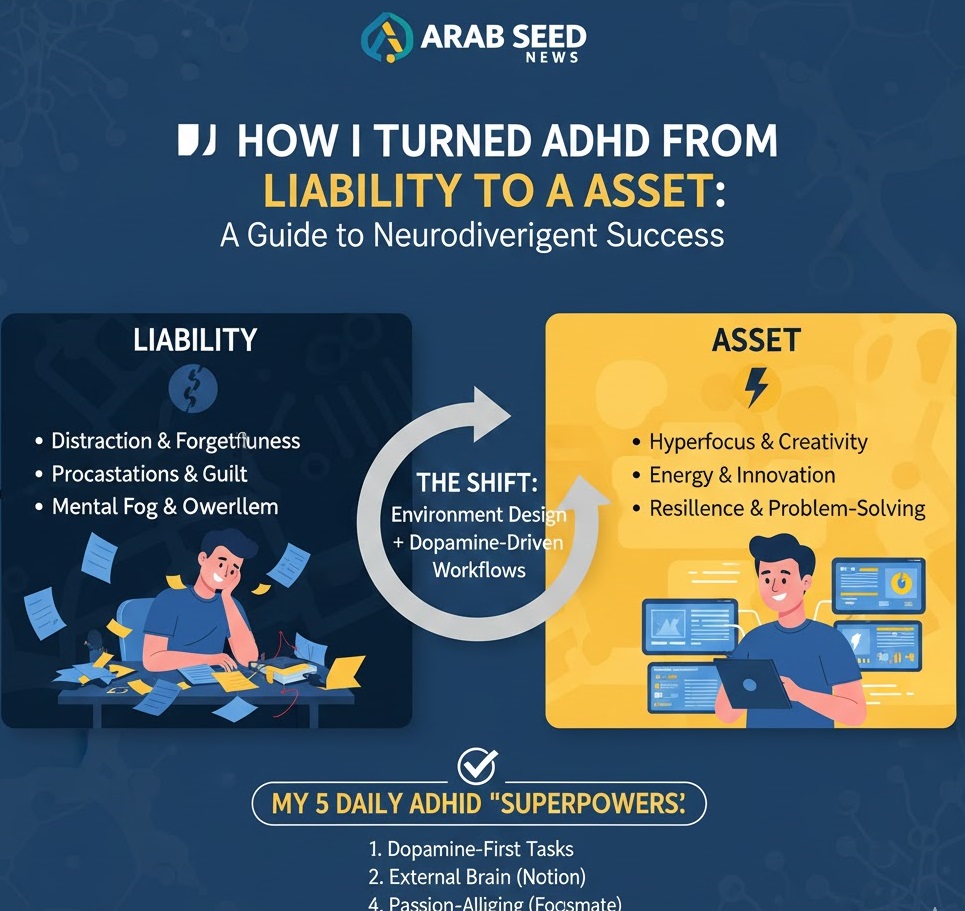
1. Rebranding the “Hyperfocus” Superpower
The world often sees ADHD as an inability to pay attention. In reality, it is a difficulty regulating attention.
-
The Liability: Focusing on the wrong things for hours (like a Wikipedia rabbit hole).
-
The Asset: Hyperfocus. When I find a project I’m passionate about, I can achieve a “flow state” that allows me to do 10 hours of work in three.
-
The Strategy: I now align my career with my interests. By choosing work that naturally triggers my curiosity, I leverage hyperfocus to outpace my peers.
2. Embracing “Dopamine-Driven” Productivity
Neurotypical productivity advice says: “Do the hardest task first (Eat the Frog).” For an ADHD brain, this is a recipe for paralysis.
-
The Shift: I use Dopamine-First Workflows. I start my day with a small, high-interest task. This “wins” me a hit of dopamine, which provides the fuel to tackle the boring-but-necessary tasks later.
-
SEO Tip: If you’re searching for “ADHD executive function tips,” remember that your brain runs on interest, challenge, novelty, and urgency—not just importance.
3. Building an “External Brain”
My working memory is, quite frankly, terrible. Trying to remember a grocery list while thinking about a business strategy is impossible.
-
The Solution: I stopped trusting my brain to store information. I use a “Second Brain” system (apps like Notion or Obsidian).
-
The Asset: By outsourcing my memory to digital tools, my “Internal Brain” is free to do what it does best: Creative Problem Solving. People with ADHD are statistically more likely to be creative thinkers because our brains make non-linear connections.
4. The Power of “Body Doubling”
One of the most effective ADHD life hacks I discovered is Body Doubling. This is simply the act of working in the presence of someone else.
-
Why it works: It provides a subtle layer of social accountability that keeps the ADHD mind from drifting. Whether it’s a co-working space or a virtual “Focusmate” session, having a “double” turns a liability of distraction into an asset of focus.
Frequently Asked Questions (FAQs)
Can ADHD really be an advantage in the workplace? Yes. Many entrepreneurs and creatives credit their ADHD for their ability to take risks, think outside the box, and work with high intensity during crises. The key is finding a role that values innovation over routine.
How do I stop feeling guilty about my ADHD symptoms? Education is the cure for guilt. When you realize that your “procrastination” is actually executive dysfunction (a chemical issue, not a character flaw), you can stop shaming yourself and start using the right tools.
What are the best jobs for people with ADHD? Research suggests that fast-paced environments like Emergency Medicine, Entrepreneurship, Sales, and Creative Arts are excellent for ADHD brains because they provide the constant novelty and urgency the brain craves.
Conclusion: Designing a Life That Fits
Turning ADHD from a liability into an asset isn’t about “getting over it.” It’s about environment design. When you stop forcing a circular brain into a square hole, you realize that your neurodiversity is actually a gift of high energy, rapid synthesis, and unique perspective.
Do you have a specific ADHD challenge you’re struggling with? Let’s chat in the comments—I might have a “hack” for you!