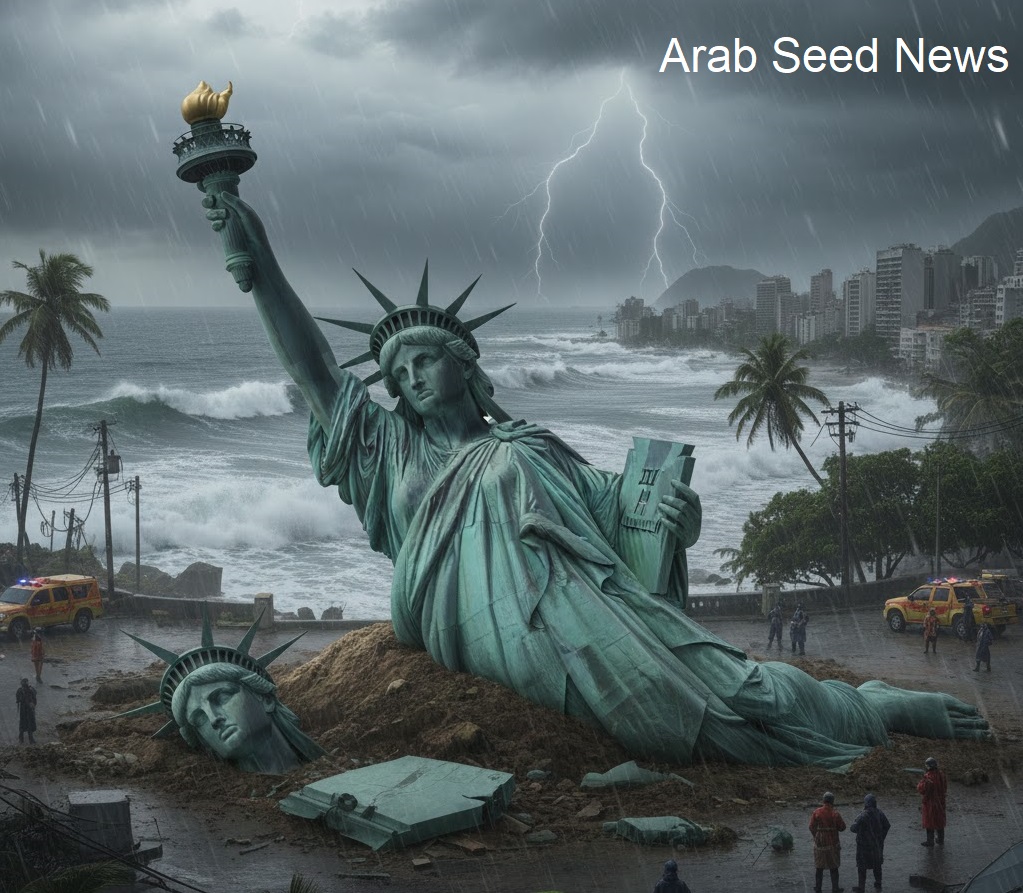
Statue of Liberty Replica Collapses in Brazil After Violent Storm.
A 24–40 metre replica of the Statue of Liberty toppled in Guaíba, Brazil after a severe storm; dramatic footage shows the monument bending and collapsing, but authorities confirmed there were no injuries.
What happened and where
A towering replica of the Statue of Liberty collapsed on December 15, 2025, in Guaíba, a city in Brazil’s southern state of Rio Grande do Sul. The monument, installed outside a Havan megastore, was struck by a line of violent storms that produced gusts strong enough to tear the structure from its pedestal and send the upper sections crashing into the parking lot. The incident was captured on video and circulated widely on social media, drawing immediate attention both locally and internationally Gulf News.
Scale of the damage and safety outcome
Reports vary slightly on the exact height of the replica, with accounts describing it as roughly 24 metres (78 feet) to nearly 40 metres (114 feet) tall, but all sources agree the collapse was dramatic and destructive. Footage shows the statue leaning under intense wind before breaking apart; the head and upper sections were crushed on impact while the pedestal remained largely intact. Local authorities and Havan officials confirmed that no injuries were reported, a fact credited to the timing of the storm and the largely empty parking area at the moment of collapse.
Meteorological context
Meteorologists and local officials attributed the failure to extreme wind gusts, estimated in some reports at 80–90 km/h, which accompanied a fast‑moving storm front across the region. Such gusts can exert enormous lateral force on tall, slender structures—especially those not originally engineered for hurricane‑level loads—making them vulnerable to catastrophic failure during severe weather events.
Engineering and public safety questions
The collapse has reopened questions about the engineering standards and anchoring systems used for large roadside monuments. Havan, the retail chain that owns several similar replicas across Brazil, stated that the statue had been installed in 2020 and complied with technical and engineering standards, but the company has not yet released a detailed structural assessment or timeline for removal of debris and reconstruction. Experts say post‑incident inspections should focus on foundation integrity, welds and fasteners, and whether the structure’s design accounted for extreme lateral loads and local wind patterns.
Community reaction and broader implications
Locals and online viewers reacted with a mix of shock and relief—shock at the spectacle of the fall, relief that no one was hurt. The viral videos prompted debate about public safety, corporate responsibility, and the visibility of large commercial monuments in urban and suburban landscapes. For many, the images were a stark reminder of how quickly extreme weather can turn a familiar landmark into a hazard.
What comes next
Authorities will oversee debris removal and an investigation into the collapse. Havan and municipal officials are expected to coordinate on cleanup and any potential reconstruction plans, while engineers will likely examine whether similar structures elsewhere require reinforcement or re‑evaluation. The episode underscores the need for rigorous structural standards and proactive risk assessments for large public installations in an era of increasingly volatile weather.