By: Arab Seed News Editorial Team
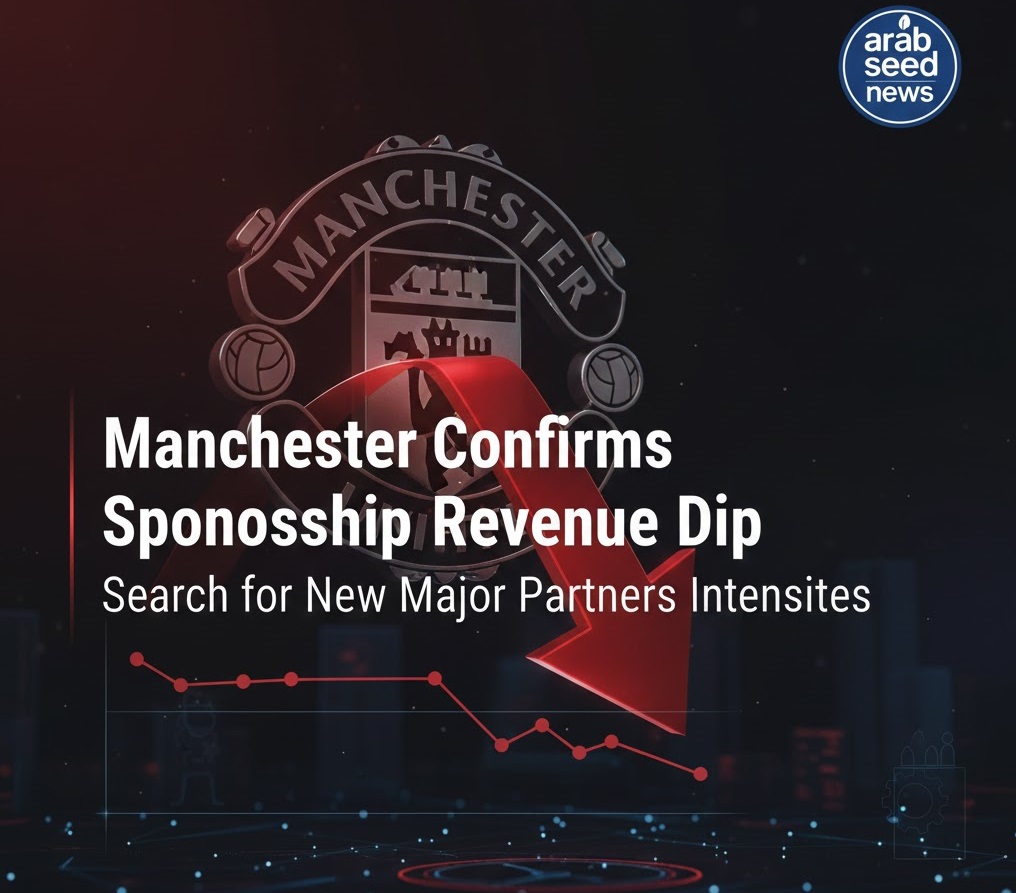
Manchester United has confirmed a notable drop in sponsorship revenue in its latest first-quarter financial report, raising new concerns about the strength of the club’s commercial strategy at a time when several major deals are nearing expiration.
The report shows that sponsorship earnings fell to £47 million, down £4.8 million from the same quarter last year — a 9.3% decline. According to the club, this decrease is largely the result of shifts in their commercial portfolio following the end of their training-kit partnership with Tezos.
Earlier this year, the Manchester Evening News highlighted that the Tezos agreement was approaching its expiry date during the summer.
I. The Training Kit Gap: Tezos Exit Leaves a Big Hole
The termination of the Tezos training-kit sponsorship is the main driver behind this revenue dip. Tezos, which replaced AON in 2022, had signed a deal estimated at £24 million per season, securing prime placement on the men’s and women’s first-team training gear for three full seasons.
Despite the overall decline, sources inside the club stressed that sponsorship income actually increased slightly when the missing training-kit revenue was excluded. This indicates that other commercial partnerships remain stable — or have even improved — as United works to secure a new headline training-kit sponsor.
II. More Trouble Ahead? DXC Technology Deal Nearing Expiry
Complicating matters further is the looming expiration of Manchester United’s sleeve sponsorship deal with DXC Technology at the end of the 2025/2026 season.
DXC signed on in 2022 with an agreement valued at around £20 million annually, providing the tech firm with global visibility across all of United’s kits — home, away, and third. The partnership also extended into digital innovation initiatives designed to enhance the club’s online fan experience.
The potential loss of both the training-kit sponsor and sleeve sponsor within such a short period places substantial pressure on United’s commercial team to quickly secure new, high-value partners.
III. What’s Next? Commercial Pipeline Shows Promise
Sleeve sponsorships first became allowable in the Premier League during the 2017/18 season, with United partnering initially with Kohler before shifting to DXC in 2022.
Although the club is currently facing a downturn in earnings — and another major deal is nearing its end — insiders insist that Manchester United has a “strong pipeline” of prospective partners. The challenge now is turning those early discussions into finalized agreements capable of filling an estimated £44 million annual revenue gap once the Tezos and DXC deals are fully gone.
Securing replacements for these two major sponsorships will be crucial not only for stabilizing the club’s financial outlook but also for proving United’s ongoing commercial appeal in the highly competitive global sports marketplace.