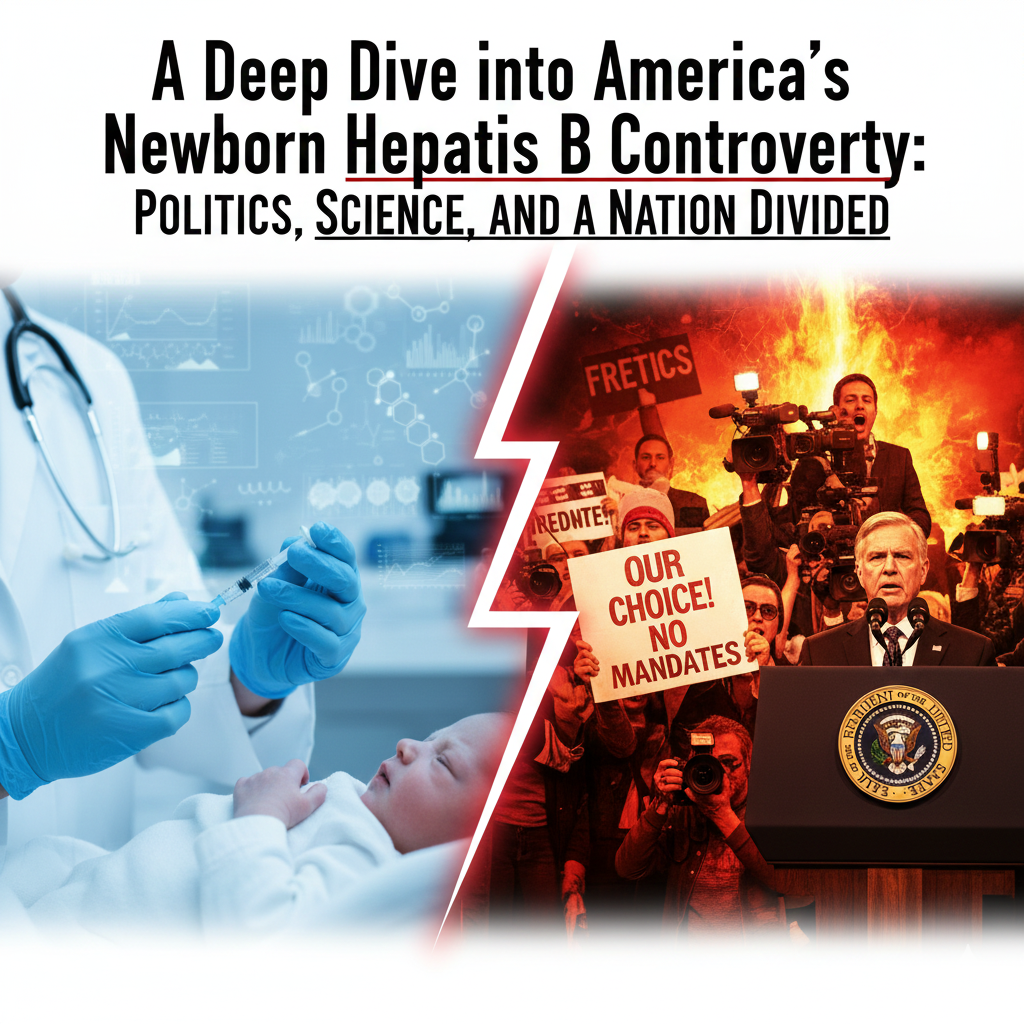
Welcome to this deep dive from Tangle, and this is an independent, nonpartisan politics newsletter that aims to summarize the best arguments from across the political spectrum on the news of the day—then give you “My Take.” Our goal is to provide truth amidst the media noise.
Today’s topic is thorny and touches almost every family: The radical change in the Hepatitis B vaccination policy for newborns in the United States, and the ensuing political and health controversy. Plus, a tour of the most important global and domestic news.
The Main Topic: New and Controversial Guidance on the Hepatitis B Vaccine
In a striking shift last Friday, the Advisory Committee on Immunization Practices (ACIP) of the U.S. Department of Health and Human Services voted 8–3 to eliminate a longstanding recommendation. This recommendation, which had been in place for decades, mandated that all newborns receive the first dose of the Hepatitis B vaccine immediately after birth.
Instead, the committee recommended a new approach: Women who test negative for Hepatitis B should consult with their doctors to determine whether their babies should be given the first dose. The new proposal suggests delaying the initial dose until the infant is at least two months old, except in specific cases.
Context: Why Now? And Who is Behind the Decision?
To understand what happened, we must understand the role of this committee (ACIP). It develops recommendations for the Centers for Disease Control and Prevention (CDC) on safe vaccine use and immunization schedules for children and adults in the U.S. These recommendations are not just ink on paper; they directly impact insurance coverage and federal health programs for vaccines.
The political background here is crucial. Last June, Health Secretary Robert F. Kennedy Jr. (known for his vaccine-skeptical stances) fired all 17 committee members, claiming they were incapable of independently evaluating vaccine safety and efficacy. Since then, Kennedy has appointed new members, many of whom are open critics of vaccines.
Notably, in the recent meeting, the committee reached its decision after hearing presentations from several vaccine critics, while subject-matter experts from the CDC were absent from presenting—a highly unusual occurrence.
What is Hepatitis B and Why Do We Fear It?
Hepatitis B is a virus that attacks the liver and can cause acute and chronic infection. The risks involved are not minor; it can lead to severe liver damage (cirrhosis), liver cancer, and even death.
Prior to Friday’s vote, the CDC had recommended for over three decades that infants receive the first dose of the vaccine:
Within 12 hours for newborns of infected mothers.
Within 24 hours for all other newborns.
Doctors and public health experts have widely credited this vaccine with significantly curbing the spread of the virus in American society.
Arguments For and Against the Change
The Argument of the New Committee (Proponents of Change): Committee members who supported the change argue that the risk of newborns contracting the virus if their mothers test negative is “very low.” They called for more substantive studies to determine if the vaccine is safe for newborns, despite past studies and long-term practice proving its safety. Dr. Tracy Beth Hoeg, the current acting director of the Center for Drug Evaluation and Research at the FDA, went so far as to argue that children should not receive the Hepatitis B vaccine at all.
The Reaction of the Medical Community (Opponents): Many medical groups, doctors, and public health experts criticized the vote sharply. The main argument is that the committee has become “ideologically driven” under Secretary Kennedy’s leadership. Dr. Debra Houry, who resigned as the CDC’s chief medical officer in August, expressed grave concern, saying, “It is heartbreaking to see this science-driven agency turn into an ideological machine.” Others warned that this change would inevitably lead to a rise in Hepatitis B cases.
President Trump’s Stance: President Donald Trump praised the committee’s new guidance, calling it “a very good decision.” He announced signing a presidential memorandum directing the Department of Health to conduct a review of childhood vaccine schedules in other countries and to “better align the U.S. Vaccine Schedule, so it is finally rooted in the Gold Standard of Science and COMMON SENSE!”