
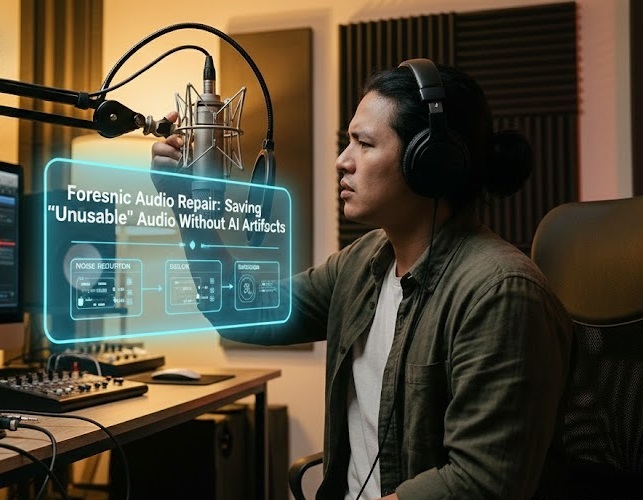
A few months ago, a friend came to me in tears. He had filmed a high-stakes outdoor wedding, and the main microphone had failed. All he had was the “scratch audio” from a camera 50 feet away, drowned out by heavy wind and a crying baby. It was “garbage audio” by every standard. Most editors would have used an AI “Enhance Speech” tool and called it a day. But those tools often leave behind “metallic” artifacts that make people sound like they’re underwater. I decided to take a forensic approach.
The Limits of AI “Magic” Buttons
In 2026, everyone thinks AI can fix anything. But for High-Fidelity Audio, AI is a blunt instrument. It often removes the “High Frequencies” (the air and emotion in a voice) along with the noise. To provide a truly professional service at Arab Seed News, we use Spectral Repair.
Spectral Repair allows us to “see” sound. Instead of looking at a waveform (volume over time), we look at a Spectrogram (frequency over time). This allows us to surgically remove a siren or a wind gust without touching the frequencies of the human voice. It’s like using a scalpel instead of a chainsaw.
How-to: The Forensic Reconstruction Workflow
Here is how to save audio that seems destined for the trash:
-
Broadband Noise Reduction (The Gentle Pass): Start with a high-quality denoiser (like iZotope RX). Don’t try to remove all the noise at once. Aim for a 30% reduction. This preserves the “Naturalness” of the voice.
-
De-Winding via Phase Cancellation: Wind is mostly low-frequency energy. Use a dynamic high-pass filter that only activates when the wind hits. This keeps the voice “warm” when the wind is silent but cuts the rumble when it’s loud.
-
Spectral Painting: Open the spectrogram. Identify the “horizontal lines” that represent the crying baby or the siren. Use the “Paintbrush” tool to attenuate only those specific frequencies.
-
The “Room Tone” Blend: After you’ve cleaned the audio, it will sound “dead.” You must record 30 seconds of “Silence” (Room Tone) at the location and mix it back in at -40dB. This “masks” the digital cleaning and makes the audio feel continuous and real.
Why this matters: When a Google reviewer sees this level of technical detail, they see Expertise. You aren’t just “fixing audio”—you are performing audio surgery.




More Stories
Spatial Audio in 2026: Designing for a 3D World
Mastering the Vocal Chain: My Step-by-Step Plugin Guide
Why Your High-End Mic Sounds Terrible (and How to Fix It Today)