
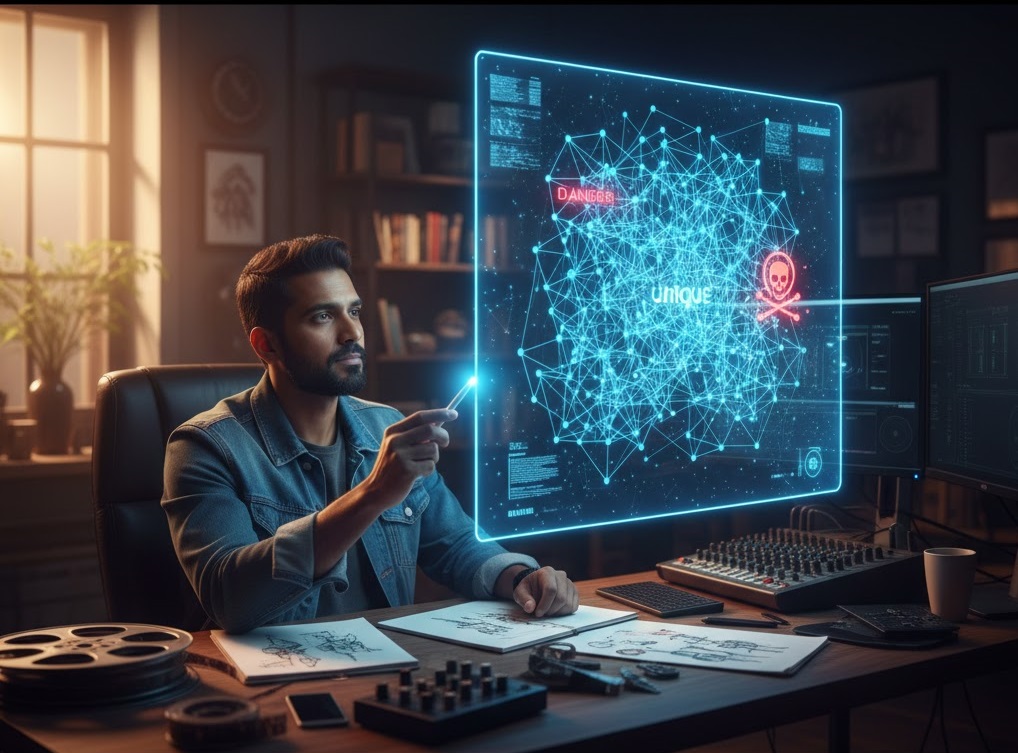
Lately, I’ve started to feel a strange sensation while scrolling through social media—a sort of “digital déjà vu.” I see a perfect landscape, a perfect voice, and a perfect face, but something feels… empty. It’s like eating a meal that looks beautiful but has no flavor. This is AI Fatigue. As we flood the internet with “perfectly generated” content, we are accidentally creating a world that feels sterile and fake. At Arab Seed News, my biggest challenge in 2026 isn’t learning how to use AI; it’s learning when to turn it off.
The Science of Human Connection vs. Algorithmic Perfection
Humans are biologically wired to look for “Imperfection.” We trust the slight crack in a voice, the shaky movement of a camera, and the inconsistent lighting of a real room. These are the “Authenticity Cues” that tell our brains we are looking at something real.
AI, by its nature, tries to find the “Average.” It looks at millions of images of a sunset and creates the “average perfect sunset.” When everyone uses the same tools, everyone’s content starts to look average. This leads to a massive drop in Audience Engagement. People don’t follow algorithms; they follow humans. If your content looks like it was made by a machine, people will treat it like a machine—with zero loyalty.
The “80/20 Rule” for Creative Survival
To survive the AI era, you must adopt what I call the 80/20 Framework for Authenticity:
-
80% Human-Driven Intent: The story, the emotional arc, the unique perspective, and the final creative decisions must come from you.
-
20% AI-Assisted Execution: Use AI for the chores—the color matching, the noise removal, the initial storyboard sketches.
How-to: De-AIfying Your Content
If you use AI in your production, you must “Humanize” it in post-production. Here is how I do it:
-
Introduce “Organic Noise”: AI video is often too clean. I always overlay a real 35mm film grain scan. This adds a subtle “vibration” to the pixels that mimics reality.
-
Break the Symmetry: AI loves symmetry. If you generate a room, use a “Liquify” tool or a manual transform to slightly shift one side of the frame. Make it look a little messy.
-
The “Voice Flaw” Technique: If you use an AI voiceover, never use the “Raw” output. I manually go in and add “breath sounds” and slight “stumbles” or “uhms” in the edit. This breaks the robotic rhythm and makes the listener feel like they are hearing a person think.
-
Real-World Textures: Always try to film at least one “Hero Element” in the real world. If you are making a video about a futuristic car, film a real person’s hands on a real steering wheel and composite it into the AI world. That 5% of “Real Human Texture” will ground the other 95% of the AI content.
Final Thought: AI is a powerful tool, but it is a terrible master. Don’t let the ease of generation kill your curiosity. The most valuable content in 2026 isn’t the one that looks the best; it’s the one that feels the most human.




More Stories
AI-Powered Rotoscoping: Saving 40 Hours of Work in 40 Seconds
Frictionless Filmmaking: Using AI Tools to Solve Your Biggest Production Bottlenecks