
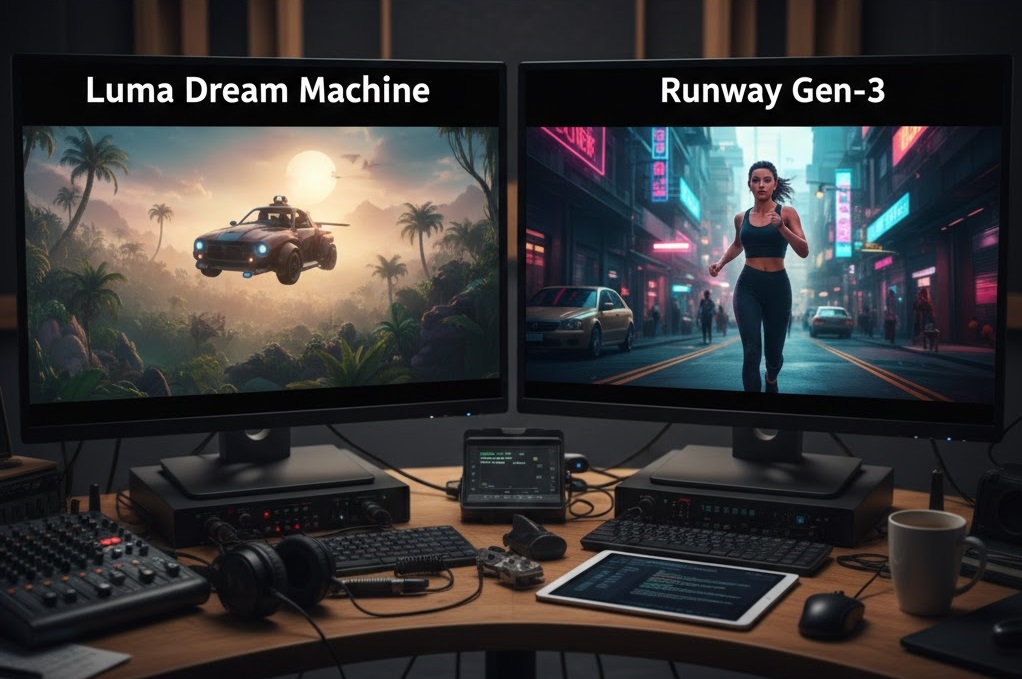
By the Arab Seed News Creative Lab
If you listen to the marketing teams at Luma and Runway, they’ll both tell you the same thing: “Our AI is the future of cinema.” But when you have a client deadline on Monday and a blank timeline in your editor, you don’t need marketing fluff—انت بحاجة لنتائج حقيقية (you need real results).
Last week at the Arab Seed News studio, we set ourselves a challenge: Create a 30-second “product reveal” commercial for a fictional high-end watch brand. We used Luma Dream Machine and Runway Gen-3 Alpha for every single shot. After 48 hours of prompting, rendering, and occasional frustration, we finally have an answer to the big question: Which one is actually ready for prime time?
1. The “Vibe” Check: Artistic Flair vs. Corporate Reality
The first thing we noticed is that these two tools have very different “personalities.”
-
Luma Dream Machine: It’s like that brilliant, moody artist who sometimes ignores your instructions but creates something beautiful. Luma’s lighting and “dreamy” transitions are unmatched. For our watch commercial, Luma produced a stunning shot of light reflecting off the glass that looked like it was shot by a professional cinematographer.
-
Runway Gen-3: This is the “corporate professional.” It’s much more obedient. If you ask for a specific camera pan from left to right, Runway does exactly that. The colors are flatter than Luma’s, but they are more “realistic” and easier to color-grade later in DaVinci Resolve.
2. Physics & Consistency: The “Liquid” Test
One of our shots required a splash of water hitting the watch. This is a nightmare for AI. Our Experience: Runway Gen-3 handled the physics of the water with incredible accuracy. The droplets felt like they had weight. Luma, on the other hand, made the water look a bit like floating mercury—beautiful, but physically “wrong.” However, when it came to the metal textures of the watch, Luma’s Ray3 engine made the steel look much more premium and expensive.
3. Control: The Editor’s True Best Friend
As editors, we hate being at the mercy of a random “Generate” button.
-
Runway’s Advantage: Runway wins the “Control War” hands down. Features like Motion Brush and Advanced Camera Controls allow us to tell the AI exactly which part of the image should move.
-
Luma’s Advantage: Luma is much better at Image-to-Video. We fed it a high-res photo of our watch, and it animated it with almost zero “morphing” (where objects change shape). If you have a great starting photo, Luma is often the faster way to get a usable clip.
The Final Verdict: Which should you use?
After finishing our 30-second edit, our team was split, but here is our professional recommendation:
-
Use Runway Gen-3 if: You are working on a commercial or a narrative film where you need precise control and shots that look like they were filmed with a real camera. It’s the tool for professionals who need to match a storyboard.
-
Use Luma Dream Machine if: You are creating mood films, music videos, or social media content where “beauty and atmosphere” are more important than strict logic. It’s for the creators who want to be surprised by the AI’s creativity.
Our Choice? For our watch commercial, we ended up using 70% Runway for the technical shots and 30% Luma for the artistic “hero” shots. In 2026, the best AI filmmaker is the one who knows how to use both.
Related posts:
 Why I Finally Switched to DaVinci Resolve in 2026 (And Why You Should Too)
 Beyond the Hype: 5 AI Tools That Actually Save Video Editors Time (Not Just Generate Clips)
 The “Dead Pixel” Nightmare: Why AI Still Struggles with Human Hands (And How We Fix It)
 Sora 2 vs. Kling AI: We Tested Both for 7 Days, Here is the Uncomfortable Truth